The Moveable Marquee:
Notes on Classic Cinema

Issue # 71 // June 1, 2026
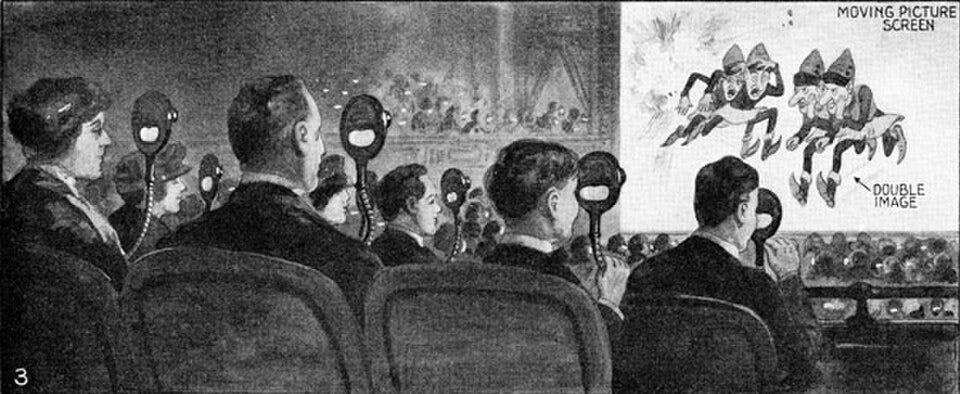
Audience at an early 3D movie, 1922
In This Issue:
Entrée: Historical Characters.
Film Commentary: Elaine May’s Mikey and Nicky
Classic Film Capsules: You Are Not I; Westfront 1918.
Sources and Acknowledgements
Entrée: Historical Characters
Last week I watched The Six Triple Eight (2024) with my wife. It’s a story of a black women’s Army unit in World War II that almost miraculously sorted and delivered a backlog of around seventeen million letters to and from soldiers, thus boosting morale in the fighting forces. In the film they get support from President Franklin and Eleanor Roosevelt who have to put pressure on Army brass to allow the work to go ahead. It’s a good film, well made by Tyler Perry.
But Susan Sarandon looks like Eleanor after a crash diet. Sam Waterston as FDR looks like, well, Sam Watertson in a wheelchair. Maybe if they’d bulked him up a bit and put a cigarette holder in his mouth he might have passed.
Mostly, films do a good job of casting historical characters, I mean by appearance. Two recent examples: Gary Oldman as Winston Churchill in Joe Wright’s Darkest Hour, and Brendan Fraser as Gen. Eisenhower in Anthony Maras’s Pressure. But I see a trend of complacency in recent years. Maybe they think that the public has no clear idea of what the characters looked like. Leonardo DiCaprio in Martin Scorsese’s The Aviator does not look like Howard Hughes—not even a little. That Scorsese cast Al Pacino as Jimmy Hoffa in The Irishman is problematic. First, he looks nothing like Hoffa; moreover, giving the impression that Hoffa (likely killed by a mob gunman) was Italian distorts the story. Hoffa was German-Irish.
Anyone who was alive and conscious in the late 1950s or early ‘60s, would know that Armando Iannucci, director of The Death of Stalin, could hardly have found an actor who looked less like Nikita Khrushchev than Steve Buscemi.
I don’t ask for spitting images.
Film Commentary:
Adventures in the Dark: Elaine May’s Mickey and Nicky
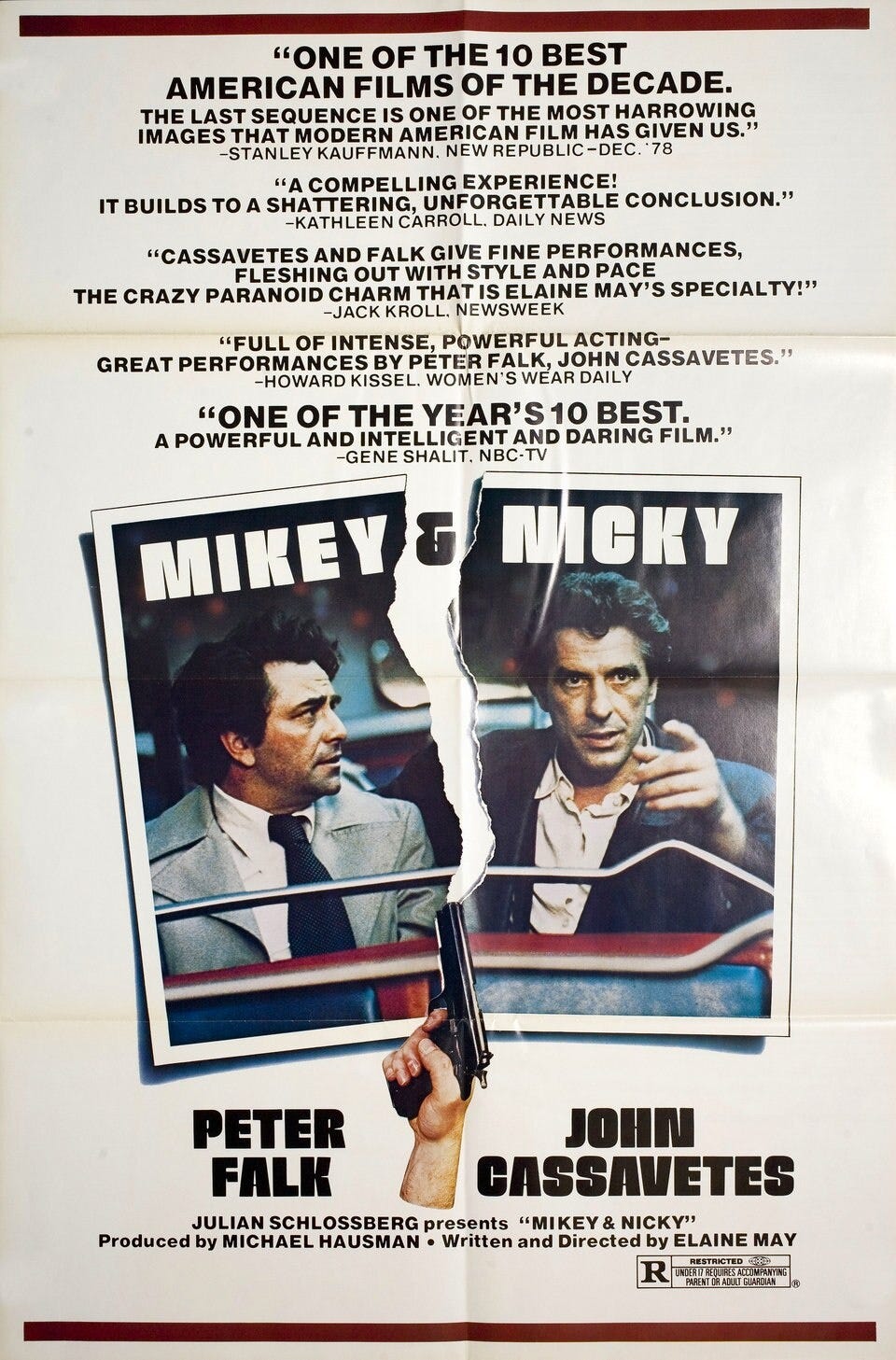
Mikey and Nicky (1976). Directed by Elaine May. With Peter Falk, John Cassavetes, Ned Beatty, Carol Grace. Written by Elaine May. Cinematography by Bernie Abramson, Lucien Ballard, Jack Cooperman, Jerry File and Victor J. Kemper. Music conducted by John Strauss. Color. 1 hr., 46 mins.
Streaming on Criterion, and HBO Max.
One of the subgenres of film is the “buddy movie.” Two men, or women, share an adventure that takes unexpected turns, each helping the other through the hurdles. Most such stories, usually comedies, center on likeable, if flawed, characters. Often one of them has all the smarts while the other steps in quicksand. The film I wrote about in the last issue, The Man Who Would Be King, falls pleasurably in that category.
In Elaine May’s Mikey and Nicky, the buddy thing turns very dark. The two pals in the story are smalltime gangsters who go on a grimy nighttime peregrination around Philadelphia. Although a thin comic thread runs through much of the film, it makes no pretense of giving us likeable characters, but dives deep into their unkempt humanity. May’s superb direction and her fluency in the argot and realities of gangster life, as well as superb performances by Peter Falk and John Cassavetes, make it an unforgettable and challenging film.
Mikey and Nicky are men of the night. They won’t whither like Nosferatu if they don’t make it to bed before sunrise, but it’s obvious that daytime is not their world. Nicky (Cassavetes) is holed up in a sleazy hotel room, nearly insane with fear. He’s stolen money from the mob and now the don has a contract out for him. How much did he steal? He has a thousand in his pocket, but he must have stolen more. For a mere grand you might get your legs broken. Teach you a lesson. But murder is messy, and the don must pay a hit man (Beatty). To bump Nicky off for an amount that, even fifty years ago, would have been pocket change for the godfather doesn’t seem plausible. So, what did he do with the rest of the loot? We don’t know.
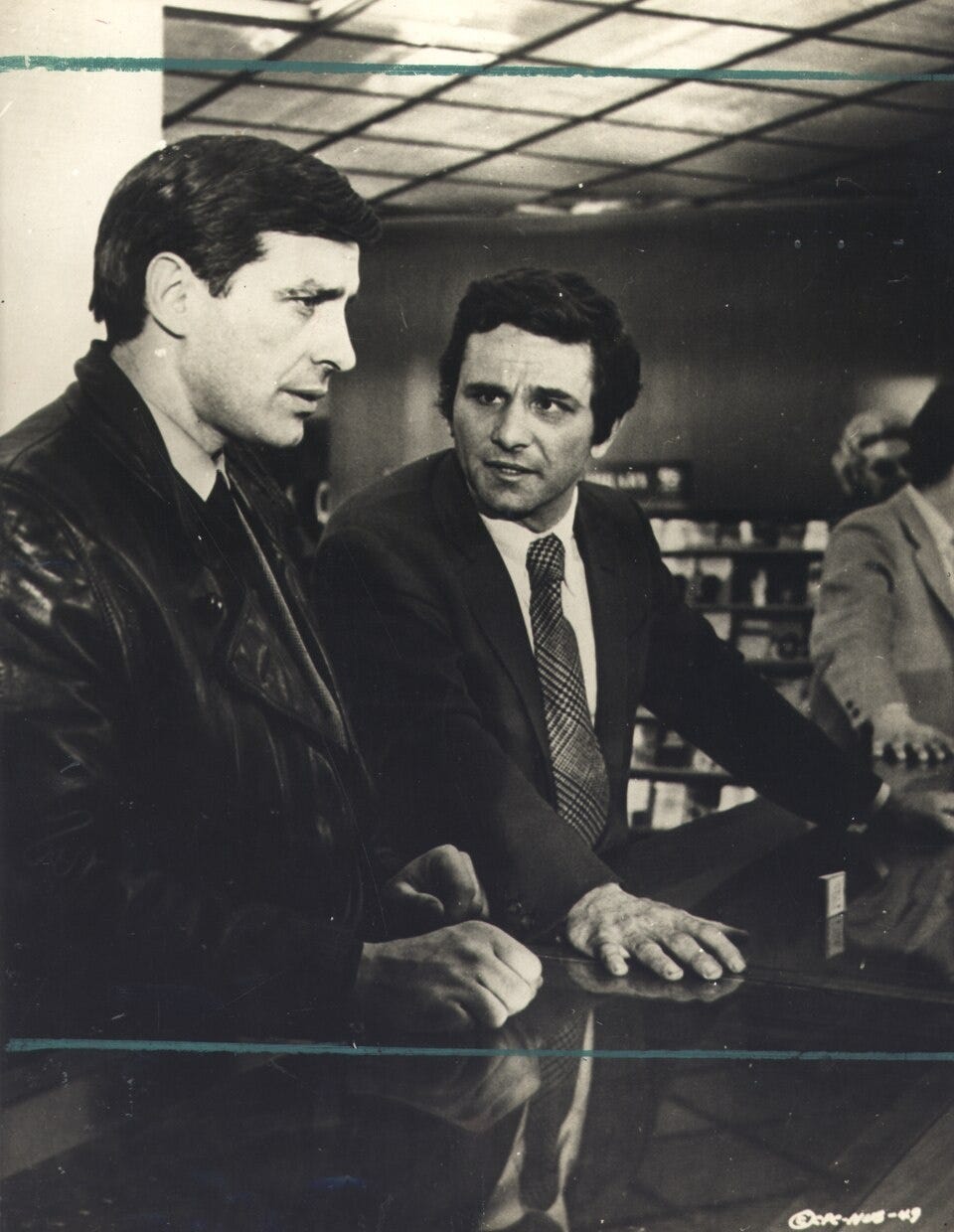
Cassavetes and Falk
Nicky makes a frantic call to his friend Mikey (Falk), also a shady character, but the only one he thinks he can trust at this moment. Mikey shows up and tries to reason with him, telling him he’s not going to die. His logic is, just because there’s a contract out for you doesn’t mean they’re really going to kill you. He tries to talk his friend into a quick flight out of town until things blow over. But Nicky is too panicky to listen to reason.
Attempting to pacify him, Mikey follows him to an all-night movie theater. But he’s too restless to stay there or anywhere else. They make a quick exit from a bar where the volatile Nicky makes a racist slur at a black man, nearly causing a fight. They visit Nicky’s girlfriend, played by writer Carol Grace (who was a friend of Truman Capote and, according to Peter Bradshaw in The Guardian, may have been the model for Holly Golightly in Breakfast at Tiffany’s). Here she plays a single woman desperate for affection, even when it means risking Nicky’s physical and mental abuse. While riding a city bus, Nicky gets in a brawl with the driver. Mikey drags him away from all of these scrapes.
However, Mikey is actually in on the hit. In fact, he’s the finger man. The phone calls he makes during this Dantesque tour, under the guise of checking in with his wife, are actually to give the hit man their locations. But he has little taste for the task, and he wants it finished and to go home to bed. When Nicky talks him into climbing over a wall to a cemetery to visit his mother’s grave, their dialogue, always terse, heats up.
Mikey: Frankly, this is ridiculous.
Nicky: You didn’t like my mother?
Mikey: I loved your mother. I thought she was a wonderful woman.
Nicky: Why is it ridiculous to visit her grave?
Mikey: Because it’s one o’clock in the morning.
Nicky: That makes it nicer.
Mikey: It doesn’t make it anything, Nick. A grave is a grave. There’s not a religion in the world that says a person’s soul is buried with them in their grave. It’s not your mother in there.
They split up after Nicky smashes Mikey’s watch, which was a gift from his deceased father. Some things are unforgivable.
Later, Mikey rides around with the hitman to help him get Nicky in his gunsights, although we get a clear sense that he’s feeling remorse and is throwing the gunman off Nicky’s trail. All this will end at daybreak with Nicky pounding on Mikey’s door, begging to get in, while the hitman’s car approaches.
May’s night photography is rich in warm tones that work so well in gangster pictures such as The Godfather and neo-noirs such Chinatown and Hamett, providing the shadows that are so satisfying in the early black and white noirs. But the evenness of the photography is remarkable since she went through five cinematographers. Reportedly, her perfectionism was unrelenting. She filmed every scene over and over, running through 1.5 million feet of film. Her finished picture is an hour and forty-six minutes, or about 9 thousand feet. That’s a shooting ratio of 166/1. A more normal ratio would be somewhere between 3/1 and 10/1. No wonder she took two years to edit.
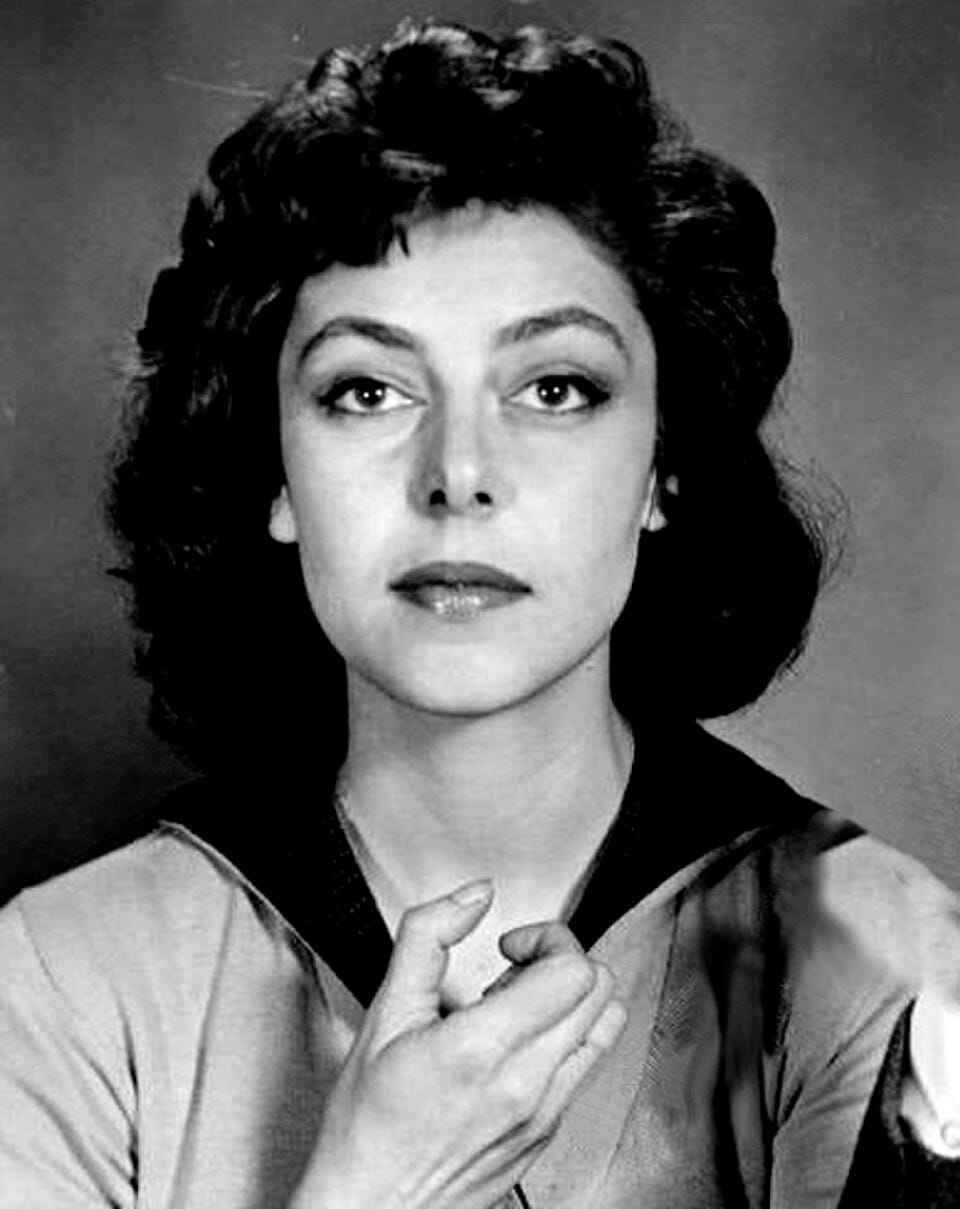
Elaine May
Elaine May was one half of Nichols and May, an improvisational standup-comedy act with Mike Nichols. When it broke up, both went into film. Nichols, of course, was far more successful with The Graduate, Who’s Afraid of Virginia Woolf, Catch 22, and on and on. May directed critically well-received, but not financially successful, films such as The Heartbreak Kid (1972) and A New Leaf (1971). Her streak ended with Ishtar (1987) a high-priced bomb. But she also worked as a writer and actor.
One of the pioneers of independent cinema, John Cassavetes (1929-1989), directed such classics as Shadows (1959) Faces (1968), Minnie and Moskowitz (1971), A Woman Under the Influence (1974), and The Killing of a Chinese Bookie (1976), although he was also an actor in many films, such as The Dirty Dozen (Robert Aldrich, 1967), Rosemary’s Baby (Roman Polanski, 1967), and played the lead in the TV detective series Johhny Staccato. Peter Falk (1927-2011), of course, was TV’s Columbo, the grandfather in Princess Bride (Rob Reiner, 1987), Sam Diamond in Murder by Death (Robert Moore,1976) and more than 130 other roles.
Unfortunately, Paramount gave Mikey and Nicky low-voltage publicity and lax distribution. Typically, studios do not know what do with films that are hard to categorize: Yes, it’s a gangster film, and a neo noir, but fits uneasily in both categories for lack of a hero, or even a likeable guy, let alone a resolution that is anything but nihilistic. Yet, few films manage to trespass so deeply, simultaneously, into two men’s murky characters.
It probably never earned back the $4,300,000 budget. But it grew legs that have carried it to enthusiastic audiences fifty years later, helped of course by the Criterion Channel.
Classic Film Capsules:
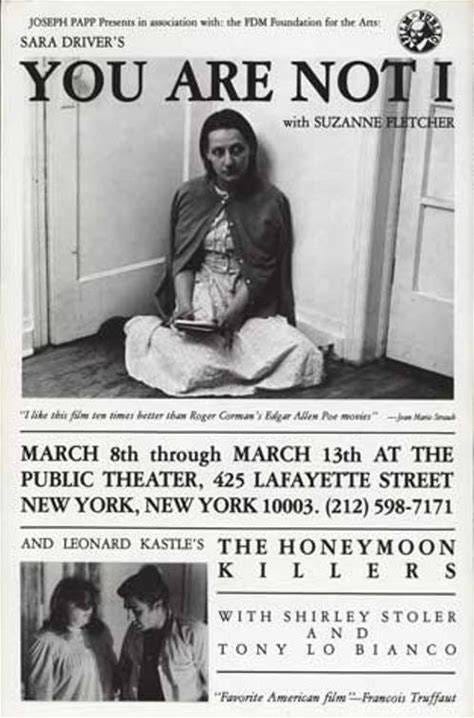
You Are Not I (1981). Directed by Sara Driver. With Suzanne Fletcher, Evelyn Smith, Lucy Sante (as Luc Sante). Screenplay by Sara Driver and Jim Jarmusch, from a story by Paul Bowles. Cinematography by Jim Jarmusch. Music composed by Phil Kline. Black and White. 50 mins. Streaming on Criterion and Prime.
Sara Driver made this short film for her MFA thesis at NYU. It was not generally released to theaters, although some critics have called it one of the best films of the 1980s. Though made on a shoestring, it carries an eerie power. Elena is an inmate in a mental asylum in Washington, New Jersey, who escapes one day in the confusion of a nearby multi-car accident with multiple fatalities. Because she seems in a daze, a Good Samaritan takes her for an accident victim and drives her to her sister’s house. Far from welcoming her home, her sister panics and calls the asylum. But when the men in white coats show up, they take the sister away. Believed lost for many years, a print of this film was found among Paul Bowles’ effects (author of the story) after his death and was later restored. Driver coauthored the script with filmmaker Jim Jarmusch (her life partner), who was also the cinematographer. Driver later directed Sleepwalk (1986), When Pigs Fly (1993) and The Bowery (short 1994), and acted in a number of Jarmusch’s films.
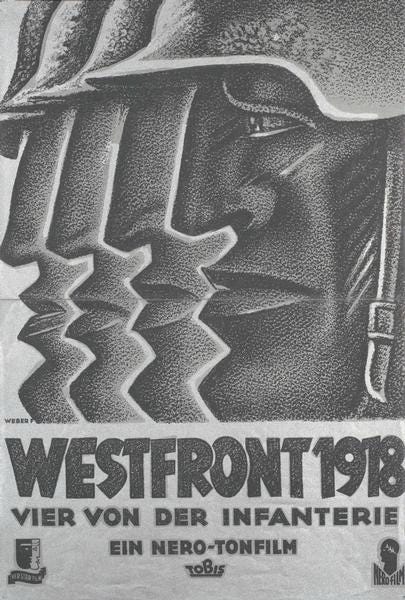
Westfront 1918 (1930). Directed by G. W. Pabst. With Fritz Kampers, Gustav Diessl, Hans-Joachim Möbis, Claus Clausen. Screenplay by Ladislaus Vajda and Peter Martin Lampel, from the novel Vier von der Infanterie, by Ernst Johannsen. Cinematography by Charles Métain and Fritz Arno Wagner. Music composed by Alexander Laszlo. Black and White. 1 hr., 15 mins. Streaming on Criterion HBO Max, Tubi and Prime.
Americans who are at all familiar with German film director George Wilhem Pabst know him as the director of Pandora’s Box, in which Louise Brooks played her immortal role of Lulu. He’s one of Germany’s greatest filmmakers. Westfront 1918, his first sound film, is clearly an antiwar story. It focuses primarily on four soldiers from dissimilar backgrounds, thrown together by the heartless and seemingly mindless machine of war: the avuncular Bavarian (Kampers); the handsome Karl (Diessl); the young idealistic lieutenant (Clausen); and one, called only The Student (Moebis), who falls in love with a peasant girl. Besides all the carnage, and horribly realistic field hospital scenes, Pabst shows—through the experience of Karl when he is on furlough in Berlin—that the fabric of German domestic life is coming unraveled. He sees lines of hungry people waiting for bread. Then climbs the stairs to his own apartment where he surprises his wife in bed with the local butcher’s son who has been buying her favors by giving her meat and saving her from starvation. He is about to shoot them both. Instead, he leaves and goes back, tragically, to his friends on the front line. Often compared to All Quiet on the Western Front (1930), both films were banned in Germany when Hitler came to power.
Sources:
Bradshaw, Peter. “Mikey and Nicky review—a neglected gem of ‘70s cinema.” The Guardian, 15 June, 2018.
Nathan Rabin. “Mikey and Nicky: Difficult Men. Criterion Essays, Jan. 22, 2019.
Schwartz, David. “’Don’t Expect to Like ‘Em’: The Making of Elaine May’s Mikey and Nickey.” Filmmaker Magazine. Thegotham.org, Dec 14, 2024.
Acknowledgments:
Thanks to Barry Voorhees for editing.
Thanks to Tim Madigan for suggestions.
QUOTE:
“Security is a false God. Begin to make sacrifices to it and you are lost.”
--Paul Bowles