
The Moveable Marquee
Notes on Classic Cinema


Louise Brooks, February 1927
# 64 // February 15, 2026
Contents of This Issue:
Entrée: Paying Attention
Film Commentary: The Perils of Nancy: William A. Wellman’s Beggars of Life.
Classic Fim Capsules: Whistle Down the Wind, and Say Amen, Somebody.
Sources and Acknowledgments
#
Entrée: Paying Attention
In a January 30 article in The Atlantic, Rose Horowitz writes that professors in film-studies programs are finding that it’s harder these days for students to hold their attention through full-length feature films. By the middle of a film, they’re “furtively checking their phones,” or losing concentration to the point that they’re unable to complete their assignments.
How long has this been going on? Well, especially since the pandemic, according to some professors she spoke with. I wonder, why would anyone who can’t pay attention to a film enroll in a film-studies program?
As distressing as this sounds, it’s hardly surprising, since so much media is hustling our attention, getting right in our faces. And with AI-sourced material coming at us at all times, it’s a veritable riot of chattering monkeys, conditioning us to lose focus.
I did not notice a particular problem with students’ attention span when I taught Writing about American Film at RIT. They had to write only three or so pages about each film, and not all wrote thoughtfully about them, but it was obvious that they’d paid attention. I hasten to add that this was more than ten years ago. So, things have changed that quickly, apparently.
But what those professors are talking about is something that many filmmakers have been aware of and responding to for some time. Increasingly I notice that in new films, especially those made for TV, something startling must happen about every five to seven minutes to hold the audience’s attention. In features watched at home, the film is competing with phone calls and trips to the kitchen for snacks.
On the other hand, there is ample evidence that the public’s interest in good cinema is alive and well. Look at the popularity of the Criterion Channel, Letterbox, Mubi and the proliferation of film festivals. Cinema is still cool. One must simply pay attention.
Film Commentary:
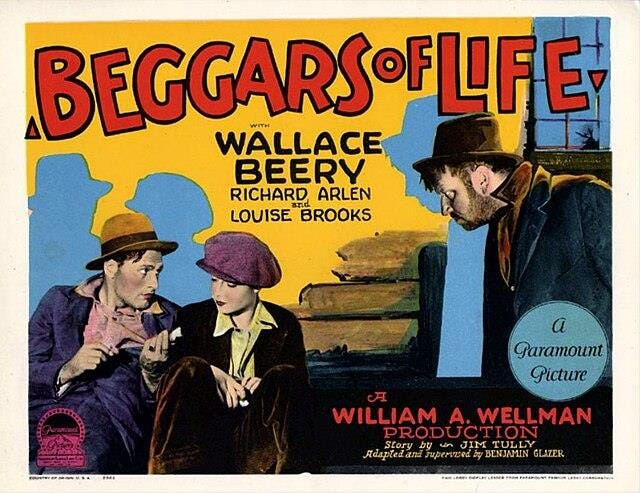
The Perils of Nancy: William A. Wellman’s The Beggars of Life
By Steven Huff
Beggars of Life (1928). Directed by William A. Wellman. With Wallace Beery, Louise Brooks, Richard Arlen, Bob Perry, Blue Washington. Screenplay by Benjamin Glazer based on a memoir by Jim Tully. Cinematography by Henry W. Gerrard. Music conducted by Manny Baer. Paramount Pictures. Silent with dialogue cards. Black and white. 1 hr., 24 mins.
Streaming on YouTube. I suggest the copy tagged: Beggars of Life (Wellman, 1928) — High Quality 1080p
In 1928 when William A. Wellman began work on Beggars of Life he was still basking in the glory of Wings (1927), his World War I air-battle movie which won the Best Picture Oscar at the first Academy Awards. In between he’d made Legion of the Condemned and Ladies of the Mob (both 1928), neither of which are particularly memorable.
This film would feature two actors he’d worked with before, Wallace Beery and Richard Arlen, both well-established stars. The real casting problem was Louise Brooks, whom he hoped to sign for the role of Nancy, a woman wanted for murder who leads police on a wild chase, traveling with hoboes. But he had trouble tracking her down. Typical of Brooks, who had recently filed for divorce from her first husband, she was incommunicado, on a long jaunt with a new beau. Though lacking the star quality of Arlen and Beery at that time, she had distinguished herself in such comic films as Love ‘Em and Leave ‘Em (1926) and A Girl in Every Port (1928). In Beggars of Life she had the opportunity to move away from comic and flapper roles for a part in a realistic drama aspiring to social relevance. Eventually, Wellman caught up with Brooks and she was signed.
Jim Tully, on whose autobiography the story is based, had himself lived as a hobo, much like the characters in the story, before becoming a boxer, a novelist (considered a literary genius by H. L. Menken), and for a time worked as a publicist for Charlie Chaplin.
Brooks found the production rough going. Against the advice of Beery, she allowed Wellman to talk her into dangerous stunts, such as hopping a moving freight train and being dumped off the back of a milk wagon, which did not endear her to the director. Moreover, Arlen (who’d worked with her before in Rolled Stockings, 1927) disliked her, and one drunken evening he told her that she was a “lousy actress” and “not even good-looking.” She made fast friends with Beery.
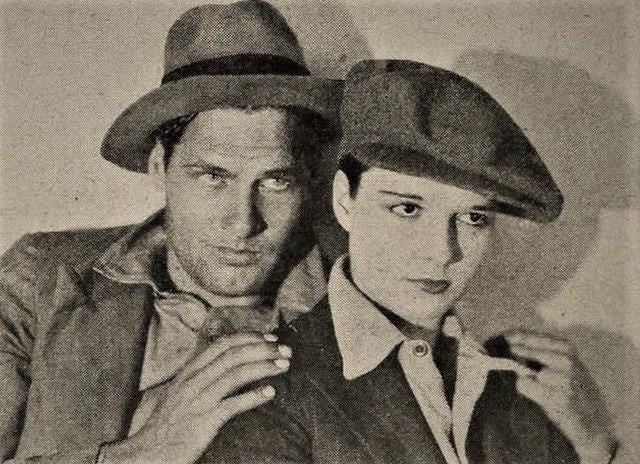
Richard Arlen and Louise Brooks
The film was unusually realistic for its time, with many of its action scenes filmed in a mountainous terrain near the Mexican border and on a San Diego and Arizona Railway train, which provided occasion for Gerrard’s rich photography. However, the filming locations represent an ambiguous region, since Arlen’s character hopes to make his way to Canada, suggesting that the action is supposed to be somewhere in the northwest.
Beggars of Life was made a year before the 1929 stock market crash, but it begs comparison to Wellman’s Depression Era movie, Wild Boys of the Road (1933) in which young people are forced out of their homes and hop freight trains. Yet the so-called Roaring Twenties didn’t roar for everyone. Bank failures and farm bankruptcies were common, and in 1928 half a million men were riding rails looking for work.
The film opens with Jim (Arlen), an unemployed man wandering the road. One morning he catches the scent of ham and eggs which he follows to the screen door of a house. He sees a man sitting at a kitchen table and calls out that he’s willing to work for breakfast. When the man neither answers nor moves, he walks in. The man is dead, with a bullet hole in his head. Cowering nearby is Nancy (Brooks), a girl the man had adopted out of an orphanage. She had shot him when he attempted to rape her, and he’d fallen back into his chair.
“He’s always been after me,” she says, “pawin’ me with his hands.”
Thus the story establishes a case of justifiable homicide. But she’s sure the law won’t buy her story. The two leave together, although Jim is reluctant to have a traveling companion, particularly one in trouble with the law. She dresses incognito in ill-fitting boy’s clothes and cap. (Interestingly, Wild Boys also features a young woman trying to slip by in boys’ clothes.). When they hop a train, they’re pushed off again by a railroad dick.
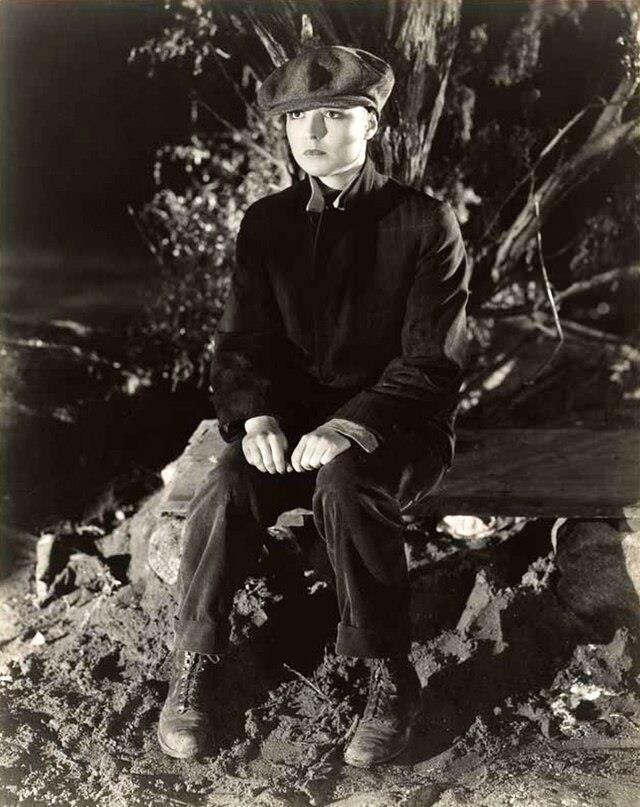
Loise Brooks in Beggars of Life
While sleeping under a haystack, they hatch a plan to go to Alberta, where Jim has ambiguous hopes of settling, and where she’d be out of reach of the police. Under a hazy moon, a hint of romance creeps into his philosophy, when he says, “Ain’t it funny when you think o’ the millions of people in warm houses and feather beds, an’ us just driftin’ ‘round like the clouds? But I guess it’s about even when you boil it down. Even them people in feather beds ain’t satisfied—we’re all beggars of life. Some begs for one thing, and some for another—and me, I ain’t found out yet what I want.”
Nancy answers, “I know what I want, just a place to be quiet in—a place to keep clean in—a place to call home.”
The next night finds them in a hobo encampment. There, once again, she faces assault, and both she and Jim are backed into a corner. An argument over allowing a murderer to hop the next freight with them becomes violent until detectives show up looking for Nancy. A scuffle ensues and the cops find themselves handcuffed to a pole.
Nancy’s travails continue in the boxcar of the train where a hobo named Oklahoma Red, played by Wallace Beery, sets up a comic “kangaroo court” to decide her fate—or rather, who is going to take possession of her. But she and Jim are inseparable, and in the ensuing plot twists they find themselves fighting off Red as well as the police who storm the train. Later, Jim and Nancy make a getaway in a car stolen by Red. With police watching the highways and railways, they seem unlikely to make it, although Red, in a dramatic change of heart, dies in a heroic act to cover their tracks.
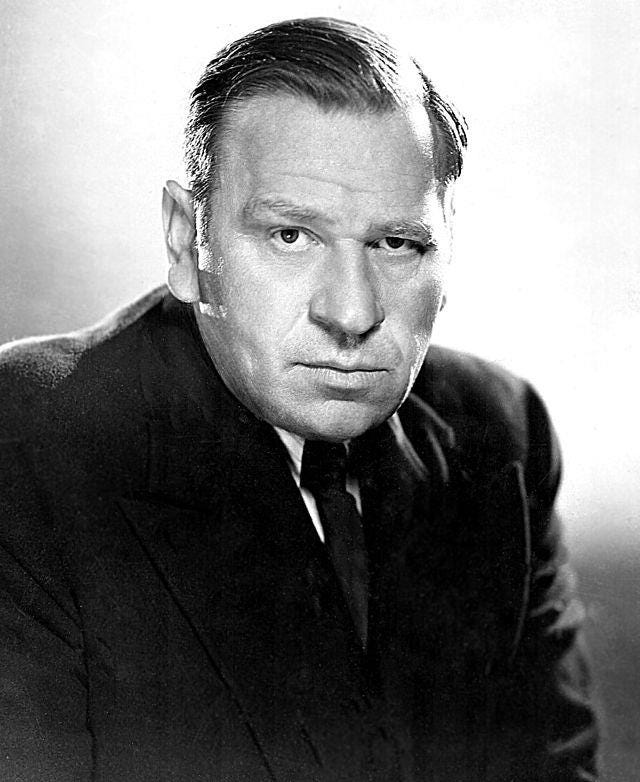
Wallace Beery
Despite improbabilities in the plot, Wellman’s Beggars of Life is an evocative ode to the stragglers and homeless in American underclasses. It avoids the predictability of a conventional Hollywood ending in that Nancy, who has been the target of the law and the caprices of men who are themselves luckless and hungry, is now heading into an uncertain and dangerous future. Moreover, it foreshadows the trials of Brooks’ Lulu in Pandora’s Box and Thymian in Diary of a Lost Girl (Both G. W. Pabst, 1929), the two films she made in Germany which were the apotheosis of her otherwise erratic career.
Of Beggars of Life, film historian Kevin Brownlow wrote, “The customary freshness and unstudied casualness of most American silent films is replaced here by a dignified, carefully studied style, suggestive of European cinema, and indicating a conscious striving toward artistry.”
Beery made 242 films, often playing the brute whose truculence conceals an inner streak of decency. He won a Best Actor Oscar for The Champ (1931). He and the immortal Marie Dressler truly endeared themselves to audiences in Min and Bill (1930) and Tugboat Annie (1932).
Brooks’s career devolved after her work in Germany. Pabst wanted to hold onto her, but she sailed for home. According to her biographer Barry Paris, she turned down a role in Wellman’s Public Enemy (1931) with James Cagney which should have kept her career on track. Instead, she never recovered from that mistake. Her last film was Overland Stage Raiders (1938) with John Wayne for Republic Pictures. At that point the name Louise Brooks was in small font on the movie posters. Republic was a “poverty row” studio, the end of the line for many actors, Wayne being an exception. Paris wrote, “Nobody burned more bridges than Louise Brooks, or left prettier blazes on two continents.”
She had a second career as a writer. In 1956, Film curator and preservationist James Card brought her to Rochester, New York, to be near the film archives of the Eastman House (Now the Eastman Museum). In her apartment on Goodman Street, she wrote numerous articles on her life in film, some of which were collected in Lulu in Hollywood with a Foreword by Kenneth Tynan, still one of the best books on the silent film era. She died there in 1985.
She wrote, “In the sixties, many schoolboys wrote to me and came to see me. Most of them knew only my name and had never seen any of my films. They approached me with wildly uniformed flattery….”
CLASSIC FILM CAPSULES:
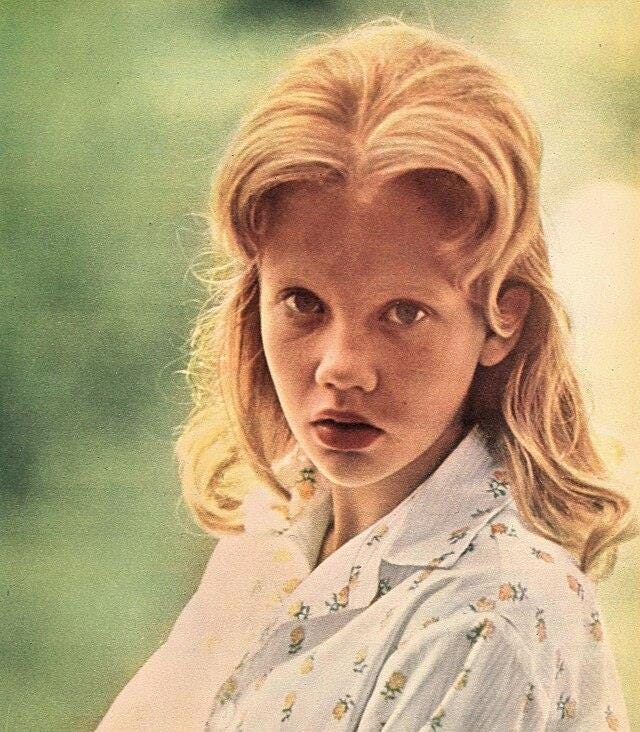
Hailey Mills
Whistle Down the Wind (1962) Directed by Bryan Forbes. With Alan Bates, Hayley Mills, Bernard Lee, Norman Bird, Alan Barnes. Written by Keith Waterhouse and Willis Hall from a novel by Mary Hayley Bell. Produced by Richard Attenborough and Jack Rix. Cinematography by Aruthur Ibbetson. Black and white. 1 hr., 39 mins. Streaming on YouTube
To appreciate this simple, charming film one must know, or recall, that beards were uncommon in 1961 when it was made. Fidel Castro had one, as did some bohemians and Gabby Hayes. But, by and large, the world of men was clean-shaven. So, when adolescent Kathy Bostock (Mills) discovers a bearded man (Bates) hiding in her family’s barn in the English countryside, she believes him to be Jesus, returned to earth. He’s actually a murderer being sought by police. She’s convinced that he’s hiding so that he doesn’t suffer crucifixion again at the hands of authorities, and she enforces secrecy on the other awed children who visit. Kathy also unwittingly supplies him with a gun. Her little Judas of a brother (Barnes), however, spills the beans. It was only the second film role for the soon-to-be-famous Bates. Rather subtle direction from first-timer Forbes (who would make The L-Shaped Room and Séance on a Wet Afternoon); he nevertheless draws strong work from Mills (whose mother, Mary Hayley Bell, wrote the original novel), and the rest of the cast. Mills was already under contract with Disney and had won the “Juvenile Oscar” from the Academy, the last time that it was awarded. Stephen Vagg of FilmInk writes that the film needs one more plot twist, and I think he’s right. In fact, the old Chekhov rule is, don’t introduce a gun unless it’s going to used. However, it’s still a very satisfying story of faith, illusion and trust.
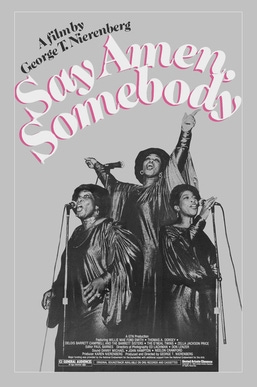
Say Amen, Somebody (1982) Directed by George T. Nierenberg. With Willie Mae Ford Smith, Thomas A. Dorsey, Sallie Martin, Edward O’Neal, Edgar O’Neal. Cinematography by Edward Lachman and Don Lenzer. Color. 1 hr., 40 mins. Streaming on Criterion.
This film on the history of African American gospel music, and the gospel music scene at the time of filming, was a hot item on the art house movie circuit in 1982. Critics sang its praises, and awards followed. It’s now recognized as one of the great documentary films of its time. In fact, it may be one of the most spirited music films ever made. Roger Ebert said, “Say Amen, Somebody” is the most joyful movie I’ve seen in a very long time. It is also one of the best musicals and one of the most interesting documentaries. And it’s also a terrific good time.” Amid the church choruses, it focuses largely on two personalities. Thomas A. Dorsey, a blues musician who had been the band leader for Ma Rainey, called the father of gospel music, for having written hundreds of gospel songs, including the famous “Take My Hand, Precious Lord.” Mother Willie Mae Ford Smith, a central figure in gospel music, was a mentor and energizer of younger singers. Nierenberg knew little about gospel music before he began researching this project, suggested to him by Ry Cooder. Its color restoration five years ago, overseen by Nierenberg, brought it to its original brilliance.
SOURCES
“Bank Failures in the 1920s: Causes and Consequences.” LegalClarity Team, Dec 12, 2025. Bank Failures in the 1920s: Causes and Consequences - LegalClarity.
Brooks, Louise. Lulu in Hollywood. Introduction by Kenneth Tynan. University of Minnesota Press, 1974, 1982.
Brownlow, Kevin. The Parade’s Gone By… University of California Press, 1968.
Louise Brooks: Looking for Lulu (1988). Documentary, directed by Hugh Monro Neely.
Movshovitz, Howie. ‘Say Amen, Somebody’ Restoration Unveils the Wonder of the Gospel Pioneers. NPR Morning Edition broadcast. February 25, 2020.
Paris, Barry. Louise Brooks: A Biography. Alfred A. Knopf, 1989. University of Minnesota Press edition, 2000.
Vagg, Stephen. “Forgotten British Film Studios: The Rank Organisation.” FilmInk Forgotten British Film Studios: The Rank Organisation, 1961 - FilmInk.
ACKNOWLEDGMENTS
Thanks to Barry Voorhees for editing.
Thanks to Tim Madigan for suggestions.
Text copyright 2026 by Steven Huff