
The Moveable Marquee
Notes on Classic Cinema

Issue # 56 / October 15, 2025
Special Issue: October Horror
With Halloween approaching, I hereby offer my annual October list of supernatural and horror films. As usual, I try to focus on films that you may not have seen before—although I know that many fans of scare flicks have searched the streaming services top to bottom looking for a frisson of fright. My tastes lean more toward ghosts and the paranormal than overt terror. Nowadays there is more gruesomeness in many war films than in those of the horror genre.
Films that frightened audiences decades ago might not scare a cat now. For example, in 1974 Linda Blair won a Golden Globe Award and an Academy Award nomination for turning her head completely around and puking green gumbo. People laugh at that scene now. King Kong scared me when I saw it in its 1956 re-release. Today a seven-year-old (the age I was then) has seen at least a thousand murders on TV, and God knows how many poor saps swallowed whole (or masticated) by film monsters far beyond the special-effects techniques of the makers of The Creature from the Black Lagoon.
This might suggest that the attraction to classic horror is now primarily nostalgic. But I don’t think that is the case. People love a good story, and the films in the list below are—in addition to being frightening, intriguing and unusual—good stories well told.
By the way, I just sorted through an online list of the “60 Best Horror Films of All Time,” and it included none of the films below, which may or may not speak well of my selections.
Thanks for being a subscriber to The Moveable Marquee. In my next issue, November 1, I will be back with my usual practice of more extensive film commentaries.
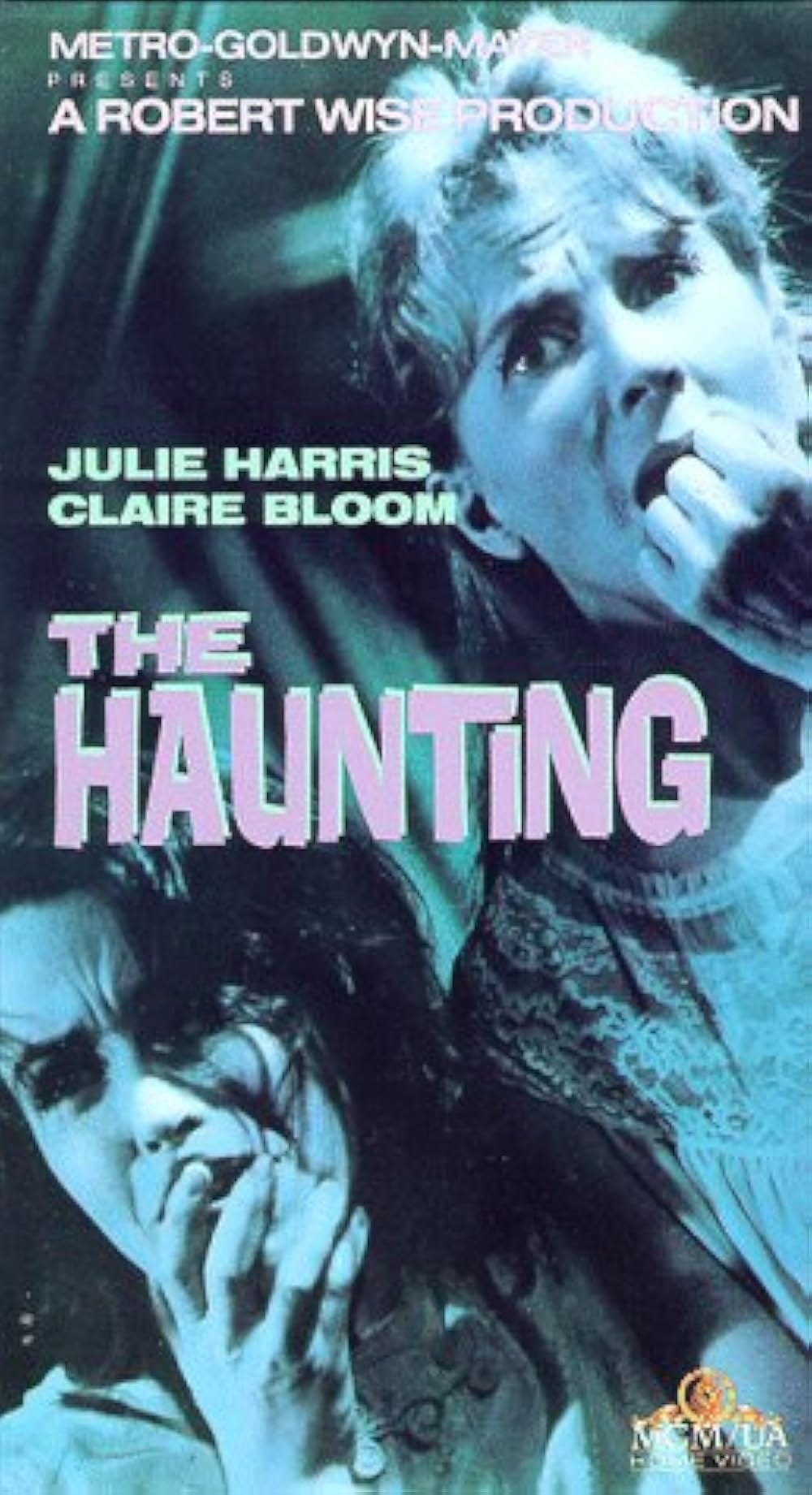
The Haunting (1963) Directed by Robert Wise. With Julie Harris, Claire Bloom, Richard Johnson, Russ Tamblyn. Black and White. 1 hr. 52 mins. Streaming on Prime.
Following a familiar conceit where a suave character hosts an evening (or two) in a haunted house—for example, William Castle’s House on Haunted Hill—a professor and investigator into the paranormal (Johnson) invites people to stay with him for a couple of evenings in a creepy old mansion. Most of the invited guests drop out at the last minute and the professor ends up with only three.
This first film version of Shirley Jackson’s The Haunting of Hill House is almost in a class of its own, owing to solid direction, great acting, and Davis Boulton’s superb black and white cinematography. Julie Harris turns in one of her most complex performances as Eleanor Lance, a sexually and socially repressed woman who accepted the invitation thinking it’s going to be her first real vacation in years. Claire Bloom as Theodora has a bit of telepathic ability herself that she uses sadistically to unsettle Eleanor. Russ Tamblyn (you may remember him from West Side Story) is in it for the jokes and the free scotch. Unidentifiable voices in the night, banging sounds, and cold drafts may be cliché, but this is a horror flick after all, and a worthy addition to the genre.
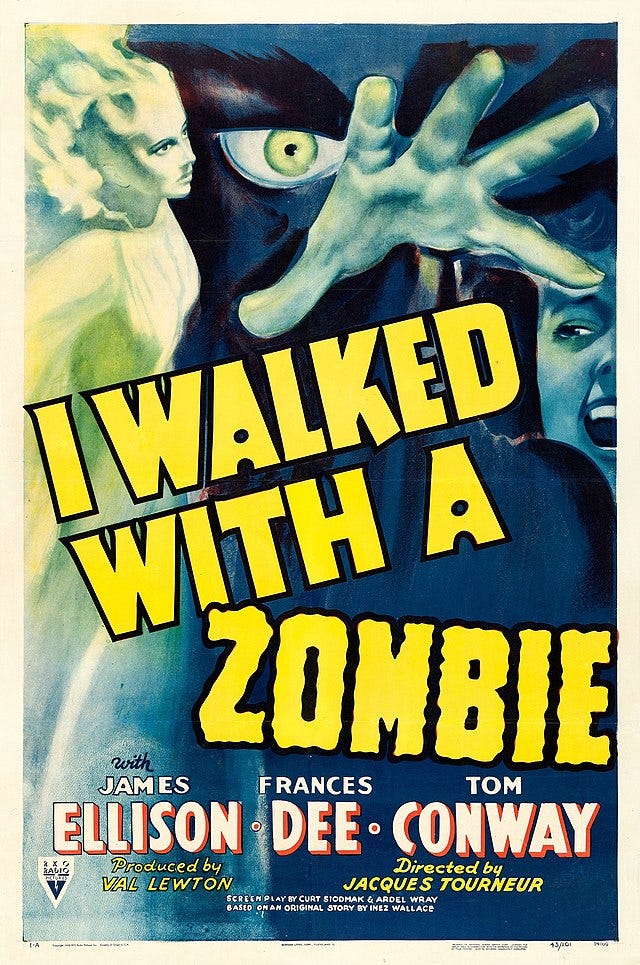
I Walked with a Zombie (1943). Directed by Jacques Tourneur. With Frances Dee, Tom Conway, James Ellison, Edith Barrett, Christine Gordon, Theresa Harris. Black and white. 1 hr., 9 mins.
Streaming on Prime
What is a zombie? asks nurse Betsy Connell (Dee) in this tale of faux medicine and Voodoo arts. She’s a Canadian hired to care for Jessica (Gordon), the wife of Paul Holland (Conway), head a family who own and operate a sugarcane plantation in the Caribbean. Jessica seems to be in a permanent zombie-like trance. The Hollands do not believe in Voodoo, which is practiced by natives on the island, and they reject any suggestion that sorcery was involved in Jessica’s illness. Betsy learns that Jessica was struck dumb just as she was about to run off with Wesley (Ellison), brother of Paul. Racked with guilt, Wesley has become an irascible alcoholic, which elevates the tension, along with ritual drums beating in the distance throughout the film.
Through her friendship with the family’s black maid Alma (Harris), Betsy learns a bit about Voodoo and decides that if Voodoo was the cause of Jessica’s illness—as Alma believes—it might also undo the damage. The film’s most exciting and frightening sequences begin one night when Betsy leads Jessica on a harrowing path through swamps and jungle to a Voodoo encampment where a mesmerizing ritual dance ceremony is in progress. When a dancer stabs Jessica’s arm with a blade, she does not bleed. More hell is afoot. French-American director Tourneur was a maestro at making atmospheric scare films such as The Cat People, The Leopard Man and Night of the Demon on typical B movie budgets.
Suspiria (1977) Directed by Dario Argento. With Jessica Harper, Stefania Casini, Miguel Bosé, Alida Valli. Color. Italy. In Italian, dubbed in English. 1 hr., 32 mins. Streaming on Fawsome, Plex, Roku Channel, Tubi (with ads) and Screambox.
The plot is simple, like most horror films, with more than its share of absurdity, yet it earns high marks for terror, and time has honored it with cult status. Director Argento is a specialist in Italian horror. Jessica Harper plays Suzy Bannion, an American dance student who enrolls in an elite German ballet school. The night that she arrives (in a rainstorm, of course), another student is brutally murdered. Who is responsible? Why do classes continue as if nothing worse than a bad cold is keeping the poor girl away? Suzy fits uneasily with other students, but she is making the best of it. Little by little she realizes that the school is run by some very strange women. Are they members of a coven of witches? Are they responsible for the murder? Who will they kill next?
The superb cinematography grabs you from the moment Suzy lands at the airport, and dazzles with extravagant use of color, particularly blood red. The production spares no expense on special effects (sophisticated for its time), but the hyperbolic use of music (by the Italian band Goblin) and sound effects threatens at times to overwhelm the film. The pace is quick, pushing toward a hellish, if somewhat crazed, climax. Remade in 2018. I chose this one over the remake—I usually go for originals. Miss Tanner, the head dance instructor, is played wonderfully by Alida Valli who was Anna Schmidt, the lead female role in The Third Man.
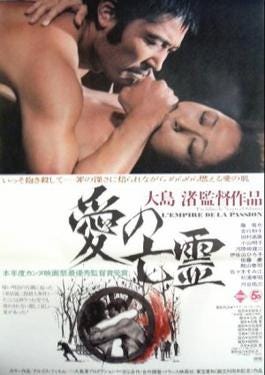
Empire of Passion (1978) Directed by Nagisa Ôshima. With Tatsuya Fuji, Kazuko Yoshiyuki, Takahiro Tamura. Japan. In Japanese with English subtitles. Color. 1 hr., 48 mins. Streaming on Criterion.
Director Ôshima won the Best Director Award at Cannes for this kaidan (Japanese ghost story), set in the late nineteenth century. Seki, the middle-aged wife of Gisaburo, a rickshaw driver, begins an affair with Toyoji, another rickshaw driver who is much younger than herself. As the affair progresses Toyoji convinces Seki to help him kill her husband. One winter night she gets Gisaburo so drunk on saki that he passes out cold. Toyoji then steps out of the shadows and the two strangle him with a rope, drag him through the snowy woods, and drop him down an unused well.
Seki is deeply unnerved by the whole business but seems to be in Toyoji’s power. She tells her neighbors that her husband has gone to Tokyo for work. But as time passes, they begin to question her story, and a policeman shows up at her house to ask uncomfortable questions. Gisaburo appears in a neighbor’s dream, then in her children’s dreams. This story of a love triangle—full of madness and guilt—transitions to a superb ghost story when Gisaburo’s spirit appears at her hearth. Beautifully photographed, with remarkable sets and superb acting, especially by Yoshiyuki, who plays the role of Seki.
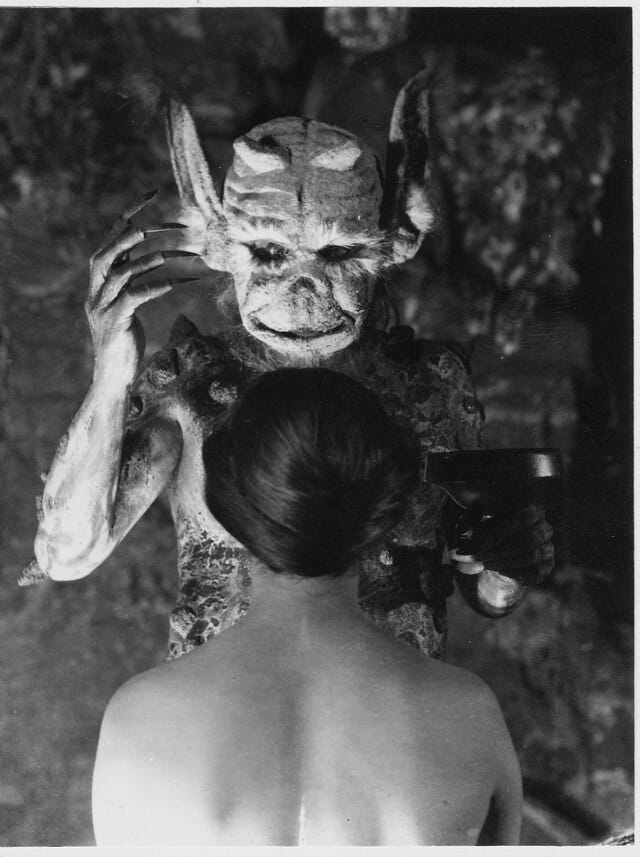
Häxan (1922) Directed by Benjamin Christensen. With Elisabeth Christensen, Clara Pontoppidan, Benjamin Christensen, Maren Pedersen. Denmark. Silent. Black and White, 1 hr., 31 mins. The Criterion copy is 1 hr. 45 mins. Streaming on Criterion, Prime, Hulu, HBO Max, Plex, Tubi (with ads).
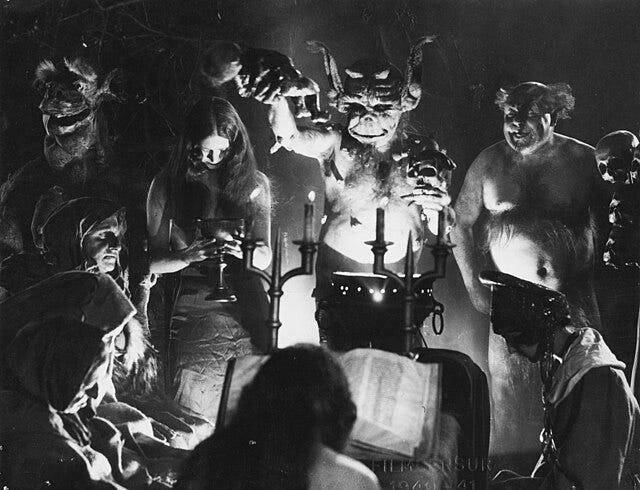
I included Häxan in my Halloween list in 2023. I’m including it again because it’s a unique and important film. With Rupert Julian’s Phantom of the Opera and F. W. Murnau’s Nosferatu, Christensen’s film is one of the great horror movies of the silent film era. It’s also unsettling as all hell. Divided into seven parts, the first is a film essay on the Malleus Maleficarum (Hammer of Witches), a fifteenth-century treatise by German monk Heinrich Kramer on demonology, Satanic ceremonies, witch-hunting, and his recommended methods of torture and execution. The next six parts, then, are dramatic vignettes depicting all the above, and sadly misled women kissing the devil’s ass. Christensen himself gets to play the devil.
For its time, Häxan was cutting edge for techniques of low-light filming and special effects, such as a giant spinning carousel constructed on the set to depict multiple silhouettes of witches flying on brooms over a city. Moreover, Christensen’s mix of documentary, historical drama, and pure fantasy was new territory for cinema. It also includes some of the earliest nudity in a feature film.
What’s most frightening is the realization that, as the film points out, Church inquisitors tortured and killed countless people—mostly women—over the centuries. As I wrote in a recent post on Theodore Dreyer’s Day of Wrath, a woman might be accused of witchcraft for being a bit odd, a non-churchgoer, or simply because she had an enemy eager to denounce her to Church authorities. Inquisitors would stop torturing a woman if she confessed to cavorting or copulating with the devil and if she also named other supposed witches. (Sounds like HUAC, doesn’t it?) Naturally, under excruciating pain, an accused might name whoever came to mind; thus the number of victims increased exponentially. She’d be burned at the stake anyway, but at least they’d take the thumbscrews off.
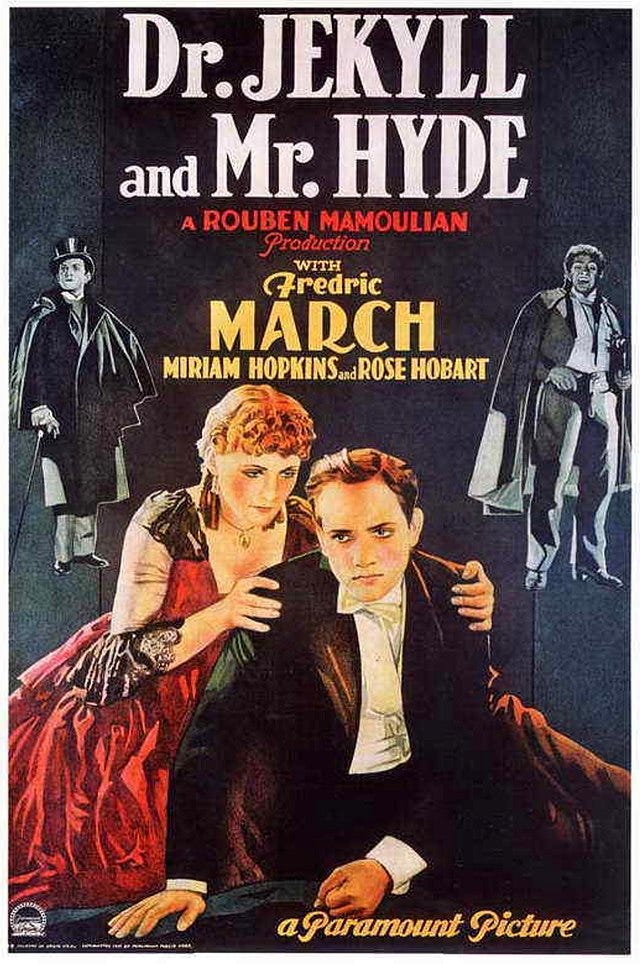
Dr. Jekyll and Mr. Hyde (1931). Directed by Rouben Mamoulian. With Fredric March, Miriam Hopkins, Rose Hobart, Holmes Herbert. Black and White. 1 hr., 38 mins. Streaming on Prime and HBO Max.
I know I’m not alone in opinion that Rouben Mamoulian’s Dr. Jekyll and Mr. Hyde (1931) with Fredric March is the best film version of Robert Louis Stevenson’s novel. The 1920 silent production with John Barrymore, and the 1941 film with Spencer Tracy, are both good. But the Mamoulian-March film best expresses the battle between benevolence and evil in the human soul, and like in Mary Shelley’s Frankenstein, the peril in traversing the provinces of nature. It skillfully turns its lens on the condescension of privilege over the lower classes. And, I would mention, since this is a Halloween list, it is truly scary.
The brilliant and celebrated Dr. Henry Jekyll (March) is engaged to Murial Carew (Hobart), a lovely and wealthy young woman, and they are both anxious to marry. However, shadows are coming to roost. Jekyll believes that the dual natures of man can be scientifically separated, discarding his evil side. His colleagues are skeptical, but Jekyll is obsessive and determined to prove his point. He drinks an elixir that he concocts in his laboratory, and things go awry. He turns into the monstrous Mr. Hyde. As Hyde, he does terrible things and becomes murderously fixated on a music-hall singer named Ivy Pearson (Hopkins). He can, and does, change himself back. But he begins having involuntary recurrences.
March is a Wisconsin native, and Hopkins is from Georgia. Both are nevertheless effective in their roles as Brits; partly, I think, because neither tries to put on a distinctive London accent. March goes through the Jekyll/Hyde transfigurations convincingly (in fact, he got the Best Actor Oscar for the dual role), while Hopkins is heartbreaking as the helpless victim.
***
Quotes:
“Three films a day, three books a week and records of great music would be enough to make me happy to the day I die.” —François Truffaut
“It was revealed to me many years ago with conclusive certainty that I was a fool and that I had always been a fool. Since then I have been as happy as any man has a right to be.” —Alistair Sim