
The Moveable Marquee
Notes on Classic Cinema

Issue # 70 //May 15, 2026
In This Issue:
Entrée: The Harry Palmer Films
Film Commentary: The Man Who Would Be King
Classic Film Capsules: Lumière, Le Cinéma!, Heat Lightning.
Sources and Acknowledgments
Entrée: The Harry Palmer Films
Len Deighton, who died in March at age 97, was never on my radar as a novelist, famous though he was. But I’ve always loved Cold-War spy movies and three of his early cloak-and-dagger novels became films. The first, The Ipcress File (Sidney J. Furie, 1965) introduced Harry Palmer, an agent in a British intelligence unit called WOOC(P), played by Michael Caine. Palmer’s insubordination, philandering and cockiness make his superiors tear their hair. But he manages to crack a complicated national security case of “brain drain” in which British scientists are captured by hostile forces and have their memory medically wiped clean.
This was followed a year later by Funeral in Berlin (Guy Hamilton, 1967), in which Palmer is sent to East Berlin to rescue a high-level Soviet intelligence officer planning to defect but who imposes a number of conditions, one being that he wants comfort and security in the west, the opportunity to grow roses, and that Palmer himself must orchestrate the escape. It’s more complicated than that, of course, but that is the gist.
Both are intriguing and good fun. However, the third Palmer film, Billion-Dollar Brain (Ken Russell, 1967), is an overblown dog, and the series, which would have included another Deighton story, Horse Under Water, was scrapped. Too bad—Palmer was at least as interesting and more believable than James Bond.
Writing recently in the London Review of Books, Thomas Jones compared the Ipcress novel’s “almost dreamlike movement of the story” to Kazuo Ishiguro or Franz Kafka, and says, “The trick is to give up trying to make too much sense of what is going on and enjoy the ride.” I’d say ditto to the film versions of both Ipcress and Funeral.
Speaking of Michael Caine, who is now 93, he stars with Sean Connery in Kipling’s story, The Man Who Would Be King (1975), the subject of this issue’s Film Commentary. Director John Huston was, I think, the best and most fearless adapter of literature-to-screen that Hollywood ever produced. I’ll name only a few films: B. Traven’s The Treasure of the Sierra Madre (1948), Herman Melville’s Moby Dick (1958), Leonard Garner’s Fat City (1972) Flannery O’Connor’s Wise Blood (1979) Malcom Lowry’s Under the Volcano (1982), and his swan song, James Joyce’s The Dead (1987). I say fearless because all these titles are classic and / or beloved works certain to bring defenders out of the woods. Moreover, it’s hard to think of another director who would even consider filming Under the Volcano or The Dead.
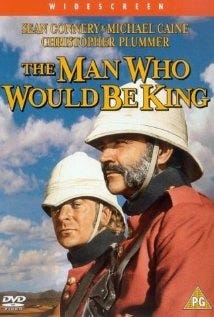
Film Commentary:
“God’s holy trousers:” John Huston’s The Man Who Would Be King.
By Steven Huff
The Man Who Would Be King (1975). Directed by John Huston. With Sean Connery, Michael Caine, Christopher Plummer, Saeed Jaffrey, Shakira Caine, Larbi Doghmi, Karroom Ben Bouih. Screenplay by John Huston and Gladys Hill, from the story by Rudyard Kipling. Cinematography by Oswald Morris. Music by the National Philharmonic Orchestra, conducted by Maurice Jarre. Produced by John Foreman. Color. 2 hrs., 9 mins.
Streaming on Prime, Tubi
For almost twenty years, John Huston mulled over the idea of filming Rudyard Kipling’s story, “The Man Who Would Be King.” He planned to cast Clark Gable and Humphrey Bogart in the starring roles of Daniel Dravot and Peachy Carnahan. But before he could get the project off the ground, death intervened for both actors, and it was shelved. Later he considered a long list of other American actors. It was Paul Newman who convinced Huston that he needed Brits in the film, since the loveable miscreants in the story are former English soldiers in India. That was good advice, as Sean Connery and Michael Caine seem born for the roles, and both turn in what is possibly the best performances of their careers. As Huston has said, “Half of directing is casting the right actors.”
He was fourteen when he first read Kipling’s story, fifty when he sketched out the project, and seventy when filming began.
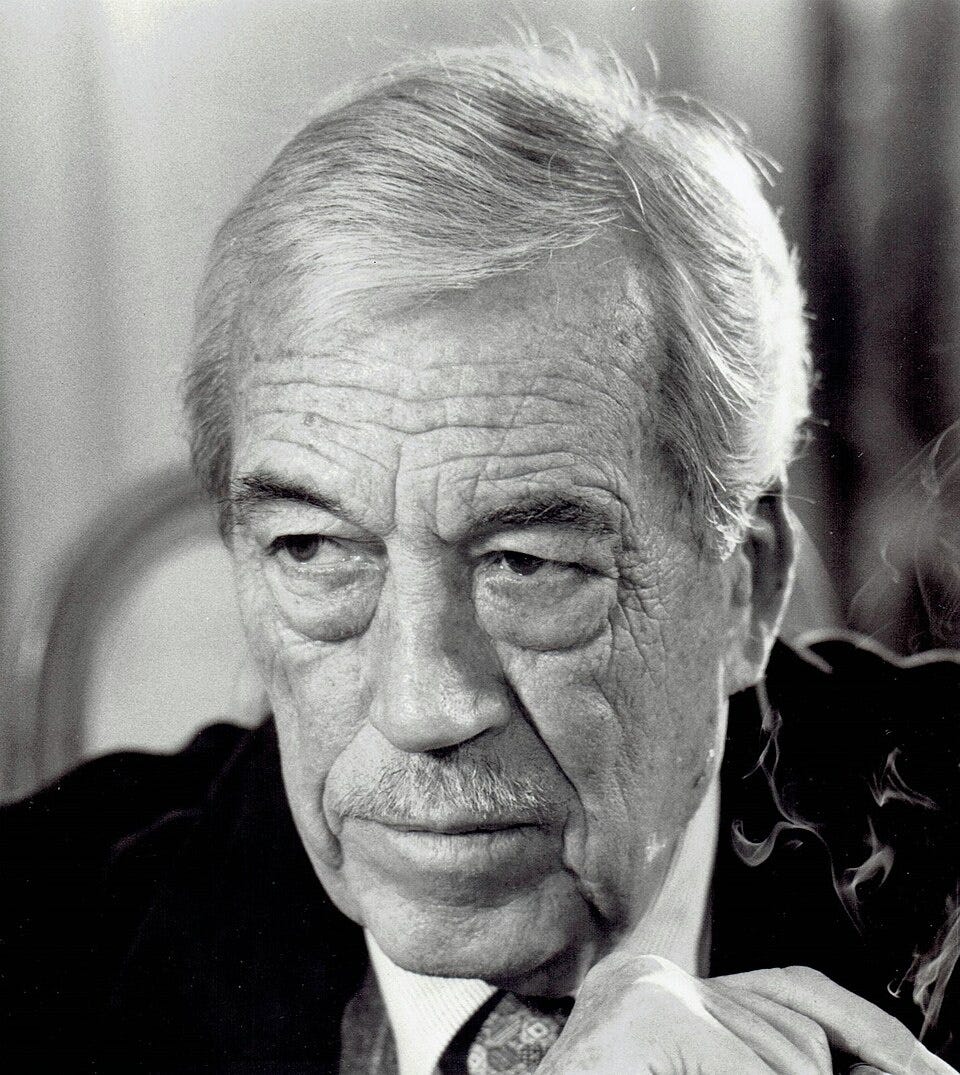
John Huston
I’ve seen it a half dozen times, and it has retained its strength over the past fifty-one years as a seriocomic tale of colonial fantasy. Or let’s call it a swashbuckler with tragic humor, rich in its improbabilities.
Danny (Connery) and Peachy (Caine) are soldiers, sometime in the nineteenth century, who resigned from the British Army while in India and have been knocking around as thieves and pickpockets since then. Finally nabbed for blackmail, it’s the local newspaper editor in Lahore, Kipling himself (Plummer), who comes to their defense and convinces the District Commissioner not to press charges.
Late one night they barge into Kipling’s office and ask him to witness a contract between them. They are going to leave their bad luck in India behind and head north into Kafiristan, part of present-day Afghanistan and Pakistan, and use their experience as officers to train an army, take over whatever kingdom is there and set themselves up as kings. And, while they’re at it, carry away whatever treasure comes with royal office and return to England as millionaires.
Christopher Plummer as Rudyard Kipling
Kipling warns them that the region is almost impassable: there is a treacherous, icy, mountain barrier, a possibly hostile enclave-culture, and no European has penetrated the area since Alexander. “Alexander who?” Peachy asks.
They start out with camels loaded with guns and ammunition, trudging over rugged terrain. But in the frozen mountains they find themselves stranded in a cave, stuck between two impassible crevasses. As they watch their fire burn low, facing death, they fall into a reflective mood. “Have our lives been misspent?” Danny asks. The ever cheerful Peachy says, “How many men have been where we’ve been and seen what we have? Bloody few!” They begin reminiscing and the echo of their hilarious guffaws causes an avalanche, creating a bridge by which they’re saved.
It’s on to Kafiristan where they meet a Gurka named Billy Fish (Jaffrey) who speaks both English and Urdu, and with him translating they succeed in raising an army and conquering one kingdom after another. When Danny is hit in the chest with an arrow, it lodges harmlessly in the ammunition belt under his clothing. But the astonished Kafiristanis, seeing him pull an arrow from his breast, now think he’s an immortal god. Moreover, he’s found by the high priest Kafu Selim to be wearing a Freemasons insignia around his neck, for which he’s believed to be the long-awaited son of Alexander who had left them twenty-two hundred years before, promising to send his son. When Danny and Peachy see the magnificent royal treasure room of gold and rubies, they gasp, “God’s holy trousers!” Unfortunately, all the ensuing pomp goes to Danny’s head. He comes to believe that it’s his destiny to be King of Kafiristan, even if it means that he also has to play god.
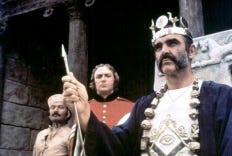
Connery as king, and Caine in background with Jaffrey as Billy Fish
When his ruse is discovered—he tries to take a wife (played by Caine’s wife Shakira Caine), who bites him during the ceremony and draws mortal blood—he’s chased onto a rope bridge. Before his pursuers cut the ropes and send him falling to the rocks below, he sings, “The Son of God Goes Forth to War.” Peachy is tortured but survives and makes his way back to India and Kipling’s office a broken man.
The film was shot primarily in Morocco for the rugged terrain and the availability of about five hundred extras; and the Grande Montée, Chamonix, France, for the snowy mountain scenes. The high priest Kafu Selim was played by Karroom Ben Bouih, a Moroccan night-watchman who was about one hundred years old. It’s his only film role. When he watched the rushes and saw himself, he said, “Now I’m immortal.”
The Man Who Would Be King is an Icarus-like tale of a man falling from the sky for over-lofty ambition. It’s also the violent end of a treasure hunter, a theme Huston explored earlier in The Treasure of the Sierra Madre. And it’s a fable of lust for power and reckless colonial hubris in which Danny Dravot and Peachy Carnahan are the tragic stand-ins for the British Empire or, for that matter, any empire. The silly portrayal of an Indian man named Babu whom Peachy kicks off a train may make you cringe. But I don’t believe there has ever been a perfect movie.
The Man Who Would Be King was nominated for four Academy Awards, for Art /Set Direction, Costume Design, Film Editing, and Best Adapted Screenplay. It is, I think, the best film of Huston’s later years.
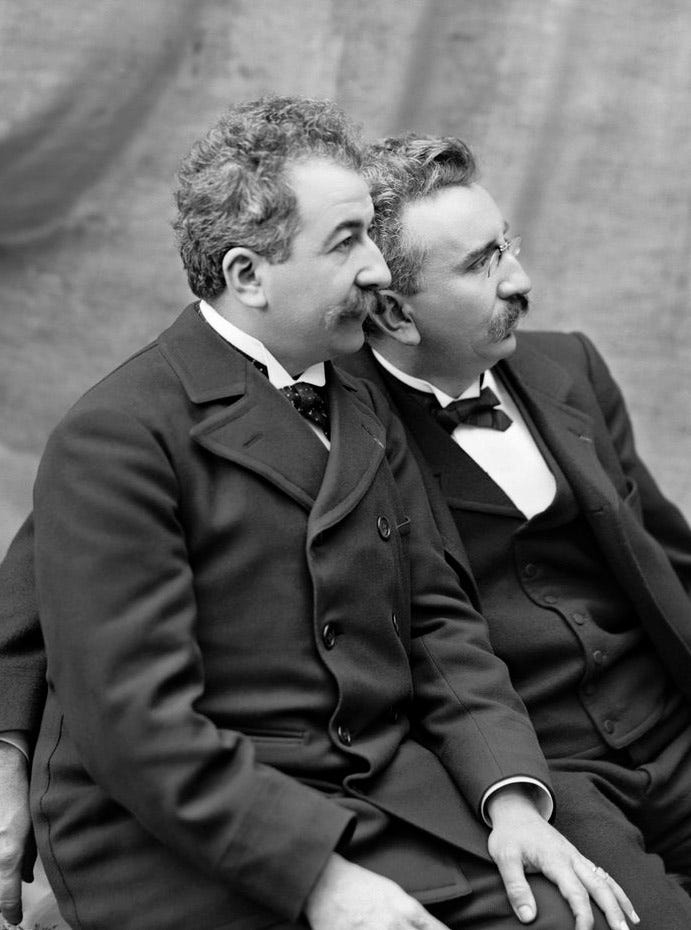
The Lumière brothers.
Classic Film Capsules:
Lumière, Le Cinéma! (2024). Directed by Thierry Frémaux. Documentary. In French with English subtitles. Black and White. 1 hr. 54 mins. Streaming on Criterion.
The first public screening of a motion picture was on December 28, 1895, at Salon Indien du Grand Café in Paris, by the brothers, Auguste and Louis Lumière, manufacturers of photographic equipment. They showed ten films on their Cinématographe projector, all under fifty seconds in length. Reportedly, audience members were awed and startled to see life-size moving images on the screen. When on another occasion they showed a train coming into a station, some audience members tried to jump out of the way. Though immortalized by this first demonstration, Louis Lumière actually made almost 1,300 short films between 1895 and 1900. Now French director Thierry Frémaux has brought together some one hundred of those short pieces in a single anthology film, Lumière, Le Cinéma!, all restored to almost pristine quality. Here are street scenes, people working their trades, such as blacksmiths and launderers. If you like the Paris photographs of André Kertész, you’ll be fascinated by these street scenes made a generation earlier. Louis went abroad with his camera to the Mediterranean, East Asia and New York, and for the first time Parisians saw moving pictures of the world beyond Europe. It’s streaming on the Criterion Channel. If you do not have access to Criterion, this film alone is worth the subscription. What the Lumières accomplished set in motion the dominant visual art form of the twentieth century.
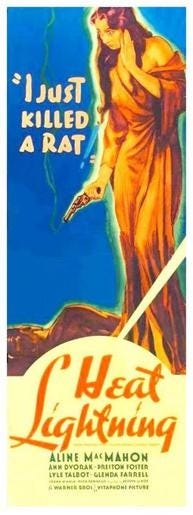
Heat Lightning (1934) Directed by Mervyn LeRoy. With Aline McMahon, Ann Dvorak, Preston Foster. Lyle Talbot, Glenda Farrell, Frank McHugh, Willard Robinson, Jane Darwell, Ruth Donnelly. Screenplay by Brown Holmes and Warren Duff, adapted from a screenplay by Leon Abrams and George Abbott. Cinematography by Sidney Hickox. Music composed by Bernhard Kaun, conducted by Leo F. Forbstein. Black and White. 1 hr., 3 mins. Streaming on Prime.
This is a forgotten gem, and a short one at 63 minutes. Two sisters run a remote gas station and diner in the California desert where temps reach 110 at midday and the night sky pulses with heat lightning. The older sister, Olga (McMahon), has a dark past but has found happiness as a car mechanic. She’s tough and cynical about men and is determined to keep her sister Myra (Dvorak), who is half mad to leave the isolation of the outpost, from going after loser men. Two criminals arrive after robbing a bank in Salt Lake City where they murdered a couple of cashiers. Of the pair, George (Preston Foster) is the heavy, and when he sees Olga, he recognizes his old lover who is deeply shaken by his unexpected presence. When two wealthy women arrive and rent a tourist cabin from Olga, they lock their jewelry in her safe. George and his partner are anxious to get to Mexico, but first he wants to bust the safe. The immortal Jane Darwell plays a short role. Sidney Hickox provides beautifully textured cinematography, although the night landscape is painted. Mervyn LeRoy, later famous for Quo Vadis (1951) and Random Harvest (1942), made solid films in the early sound era, including Little Caesar (1931), I Am a Fugitive from a Chain Gang (1932), and Tugboat Annie (1933).
Sources:
AFI Catalog of Feature Films, “Rudyard Kipling’s The Man Who Would Be King.”
Ebert, Roger. The Man Who Would Be King. Review. Rogerebert.com.
Jones, Thomas. “Deskbound Party Bastards: Thomas Jones on Len Deighton.” London Review of Books. Vol 48, No. 8, 7 May, 2026.
John Huston: A New Perspective On Directing. Documentary. Perspective. YouTube, directed by Simon Rigden Green. 2012
“The Man Who Would Be King, Directed by John Huston.” Cliomuse.com.
Acknowledgements:
Thanks to Barry Voorhees for editing.
Thanks to Tim Madigan for suggestions.

Thanks for this, Steven. Your comments never crease to be interesting