
The Moveable Marquee
Notes on Classic Cinema

Issue #67, April 1, 2026
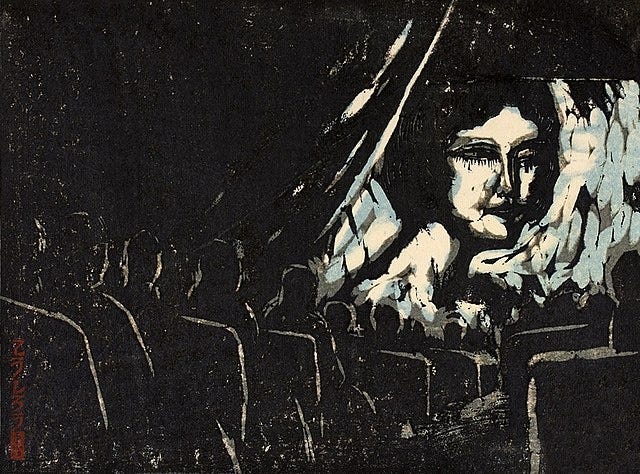
Movie Theater, Tokyo, 1929. Image by Kōshirō Onchi
Contents of This Issue:
Entrée: Roger Corman’s Centennial
Film Commentary: Stage Door
Classic Film Capsules: Fifth Avenue Girl; Primrose Path
Sources and Acknowledgments
Entrée: Roger Corman’s Centennial
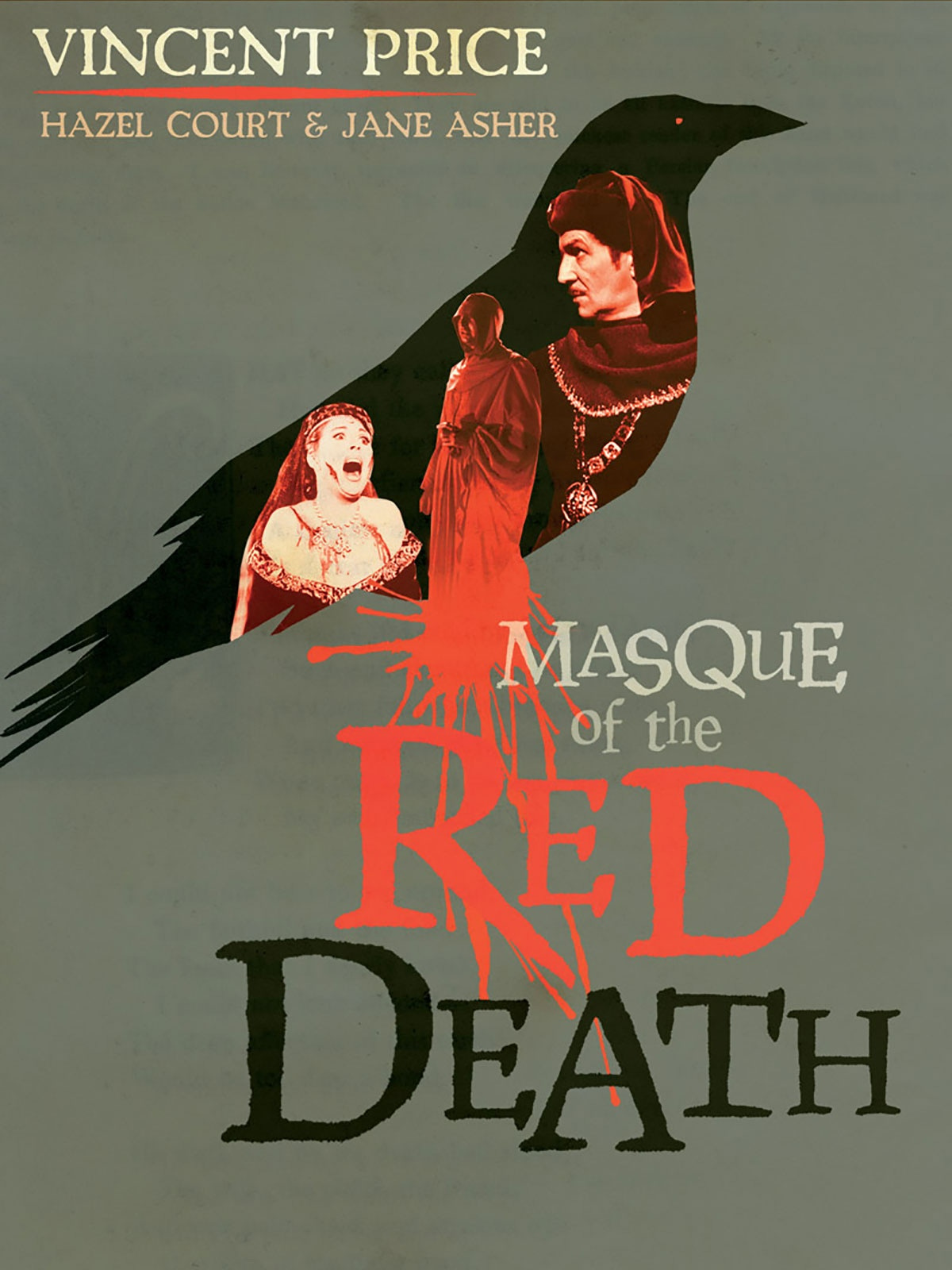
If he were still around, Roger Corman would be celebrating his hundredth birthday next Monday, April 6. The B-movie master died two years ago at the age of 98. Corman actually was many things: director, producer, actor, distributor. Yes, he made a lot of cheap movies. Some are good, and some bad, as B flicks often are. His autobiography is titled How I Made a Hundred Movies in Hollywood and Never Lost a Dime (1990). Certainly, you must spend money to lose money, and Corman had a formula for making movies on the cheap.
As a kid I loved The Masque of the Red Death (1964), The Raven (1963, which had naught to do with Poe’s most famous poem), and The Haunted Palace (1964), although even then I knew those flicks were cheapo. The biker movie, The Wild Angels (1966) was good drive-in fare. My favorite of his films is, I think, House of Usher (1960) with Vincent Price, Mark Damon and Myrna Fahey. I don’t claim to have seen most of his hundred features.
Part of his legacy is his mentorship. He produced Martin Scorsese’s first commercial feature, Boxcar Bertha (1972), as well as early features by others who later became giants: Francis Ford Coppola’s Battle Beyond the Sun (1959); Peter Bogdanovich’s Targets (1968) and Voyage to the Planet of Prehistoric Women (1968); and Jonathan Demme’s Fly Me (1973). He gave early roles to Jack Nicholson and other young actors. Television eventually replaced B-movies, and thus, the opportunities that young directors had in Corman, to learn by doing, are harder to find.
Gregory La Cava (1892-1952), the director of Stage Door, the subject of this issue’s Film Commentary, started in silent films but hit his stride in Hollywood’s Golden Age. He earned Best Director nominations by the Academy for both Stage Door, and his previous film, Our Man Godfrey (1936) with William Powell and Carole Lombard, one of the great comedies of the decade. Later he made Fifth Avenue Girl and Primrose Path (1939,1940; see Classic Film Capsules below) and Lady in a Jam (1942). He’s little remembered today. Gary Morris wrote in Bright Lights Film Journal, “Gregory La Cava is probably the greatest classic Hollywood director still in need of rediscovery.
Film Commentary:
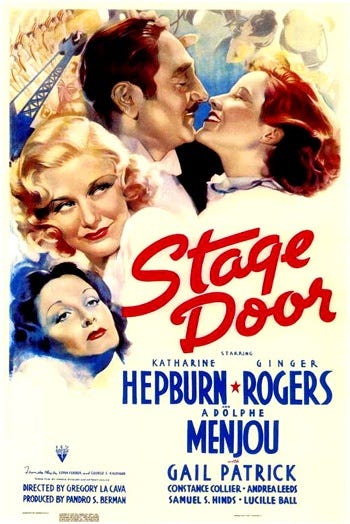
“You’re an actress now. You belong to them!” Gregory La Cava’s Stage Door
By Steven Huff
Stage Door (1937). Directed by Gregory La Cava. With Katharine Hepburn, Ginger Rogers, Adolphe Menjou, Constance Collier, Andrea Leeds, Lucille Ball. Screenplay by Morrie Ryskind and Anthony Veiller, from the play by Edna Ferber and George S. Kaufman. Cinematography by Robert De Grasse. Music composed and directed by Roy Webb. Choreography by Hermes Pan. Black and white. 1 hr., 32mins.
Streaming on Prime
In my early twenties I went to New York to be a folk singer. It was a humiliating experience, and I finally limped home dragging my guitar case behind me. I didn’t realize at the time how I was changed by that disappointment, but, as Keats would say, I “molted.” Soon enough I was on to the next thing in my life, but with less naivete. So…I understand the impetus of the wannabe actresses in a New York boarding house in Gregory La Casa’s Stage Door, their grasping for a life elevated by art. Based on the Broadway production of the same title by Edna Ferber and George S. Kauffman, the film has an outstanding cast: Katharine Hepburn, Ginger Rogers and Adolphe Menjou at the top, and a prodigy-cluster of other stars early in their careers, such as Lucille Ball, Eve Arden, Ann Miller, Gail Patrick and Andrea Leeds.
It’s hard to think of another Hollywood film of that era led by such a dynamic assembly of women actors, except, perhaps George Cukor’s The Women (1939). And yet, this assembly of beautiful dreamers who make up the emotional core of the film is under the power of men who dominate the theater industry, including the roguish producer Anthony Powell (Menjou) who maintains a casting couch in his plush apartment. Since it’s also the Great Depression, and money from home is scarce, the women date men for the sole purpose of getting a square meal. Judith Canfield (Ball) finally gives up and marries a hometown “hick” for an easier life.
The film belongs mostly to Hepburn and Rogers who have the central roles. Stage Door was one of the bright spots for Hepburn in the 1930s. After winning a Best Actress Oscar for Morning Glory (1933), she went into a slump. In view of her later career, and her imposing presence in Stage Door, it’s almost puzzling to realize that she was considered box-office poison then and casting her was risky. When she played Susan Vance in her next film, Bringing Up Baby (Howard Hawks 1937), opposite Cary Grant, it flopped. That was the last straw for her at RKO, and they cancelled her contract. It took her a while to regain her stride
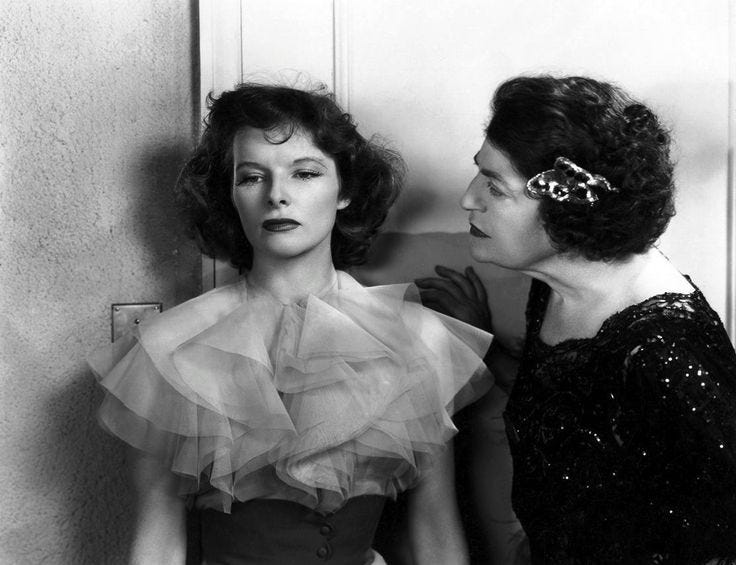
Katharine Hepburn and Constance Collier
Rogers, of course, is remembered principally for dancing (first paired with Fred Astaire in 1933 in Flying Down to Rio) and romantic comedies. But Stage Door was her best chance to prove herself a dramatic actor, and her terse zingers make the film’s best dialogue. It was the age of wisecracking women, like Joan Blondell, Mae West, and Barbara Stanwyck. Few could deliver a shot with the wit and timing that Rogers does in her role in this film as Jean Maitland.
Adolphe Menjou, the single principal male star, had perhaps the longest career in film at that point, starting in The Acid Test, in 1914. Although most of his silent films are now lost, his work with Charles Chaplin in Woman of Paris (1923) and with Ernst Lubitsch in The Marriage Circle (1924) are classics. He had a long run in films, often playing suave, impeccably dressed men, such as Monsieur La Bessiere in Josef Von Sternberg’s Morrocco (1930).
Early in Stage Door, a new actress-hopeful, Terry Randall (Hepburn) arrives at the Foot Lights Club boarding house. She exudes privilege and class, has more luggage delivered than all the other women combined, and demands a single room with a private bath. Such is not available, however, and she finds herself rooming with Jean Maitland (Rogers) who is clearly resentful of the snooty, assuming Terry.
Jean: Hmm! Fancy clothes, fancy language and everything!
Terry: Unfortunately, I learned to speak English correctly.
Jean: That won’t be of much use to you here. We all talk pig Latin.
Terry will remain a pariah in the house until one morning when she goes to Powell’s office and sees one of the others, Kay Hamilton (Leeds), who is the most beaten-down in spirit of all the girls, getting a rude brush-off by Powell’s receptionist. Terry stomps past the receptionist into Powell’s office and gives him holy hell.
He retorts, “Something ought to be done about these girls that come to New York and try to go on the stage. They’d be so much better off at home, raising families.”
Yet Powell, surprised by Terry’s pluck, thinks she has enough spirit, spunk and conceit to light up a stage. That wins her an invitation to his apartment where he’d already entertained Jean. This is not a Pre-Code film, so we’re left to our assumptions of how Terry gets a part in a play that is just going into rehearsal. The director and playwright, however, are distinctly unimpressed with her wooden performance and only her status as Powell’s protégé keeps her from getting trash-canned.
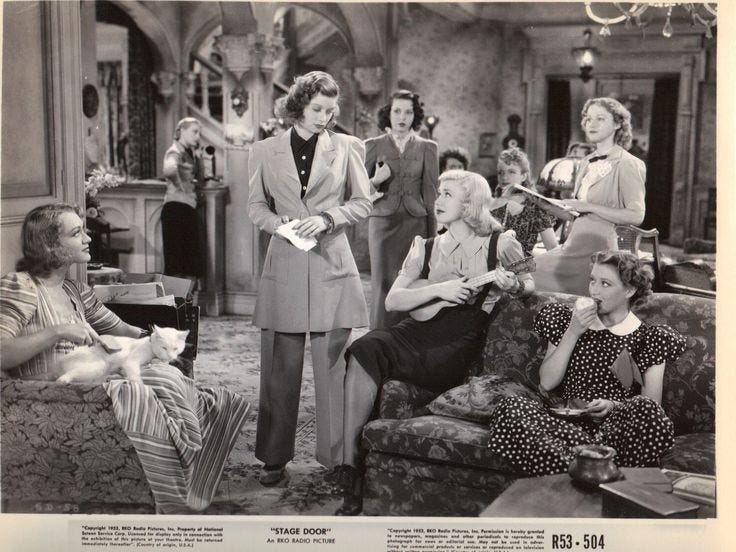
Lucille Ball, center, with Ginger Rogers on the ukelele
Terry has taken the part that Kay has dreamed of for as long as she’s lived with the other aspirants. Losing the part to the woman who had defended her, combined with starvation—she doesn’t have money to pay for meals at the boarding house—sends her from disappointment to delusion. In a deeply intense sequence, she climbs the boarding house stairs hearing voices of crowds cheering her, and she jumps from an upstairs window to her death.
Learning of Kay’s suicide, Terry is distraught and says she can’t possibly go on stage. Miss Luther (Collier), the boarding house’s resident acting coach, tells her she must go on, not just for the sake of the play itself, or art itself, but because so many depend on her, not only the director and producer and actors, but stagehands, costumers, reporters and photographers, etc., etc. “You’re an actress now. You belong to them!”
Once again, everyone in the boarding house, especially Jean, despises Terry. And yet, it is the crushing experience of Kay’s death that finally gives her the depth and sadness that she needs to raise her performance to a sensational success.
While Hepburn and Rogers dominate the film, the more unsettling and nuanced role is Leeds as Kay Hamilton, for which she was nominated for a Best Supporting Actress Oscar. The young women in the boarding house, save for Terry, represent the majority of people who fall to the wayside in the entertainment world. Some survive on humor, cheap stew, and passion. But Leeds’s Kay is the face of the dire, soul-eating consequences of failure. In the arts you dream of transcendence, and then the door closes in your face.
RKO Pictures bought the film rights to the play in 1936 for $130,000 (about 3 million in 2026 dollars) and put a team of screenwriters to work on it, principally Morrie Ryskind and Anthony Veiller, who together were nominated for Oscars for Best Adapted Screenplay. Ryskind was renowned for writing three Marx Brothers films, Coconuts (1929), Animal Crackers (1930), and A Night at the Opera (1935), and got a previous Adapted Screenplay Oscar nomination for My Man Godfrey (1936).
Stage Door has enough comic moments for James Harvey to list it among comedies in his book, Romantic Comedy in Hollywood: From Lubitsch to Sturges. But Kay’s emotional dissolution and suicide—combined with the imperative that “the show must go on,” regardless of what has happened, takes it in a serious direction that one can feel building by the middle of the picture. At the end, a new wannabe enters the boarding house, bright and starry-eyed. She’ll be taking Kay’s old room.
Classic Film Capsules: Two more from Gregory La Cava and Ginger Rogers.
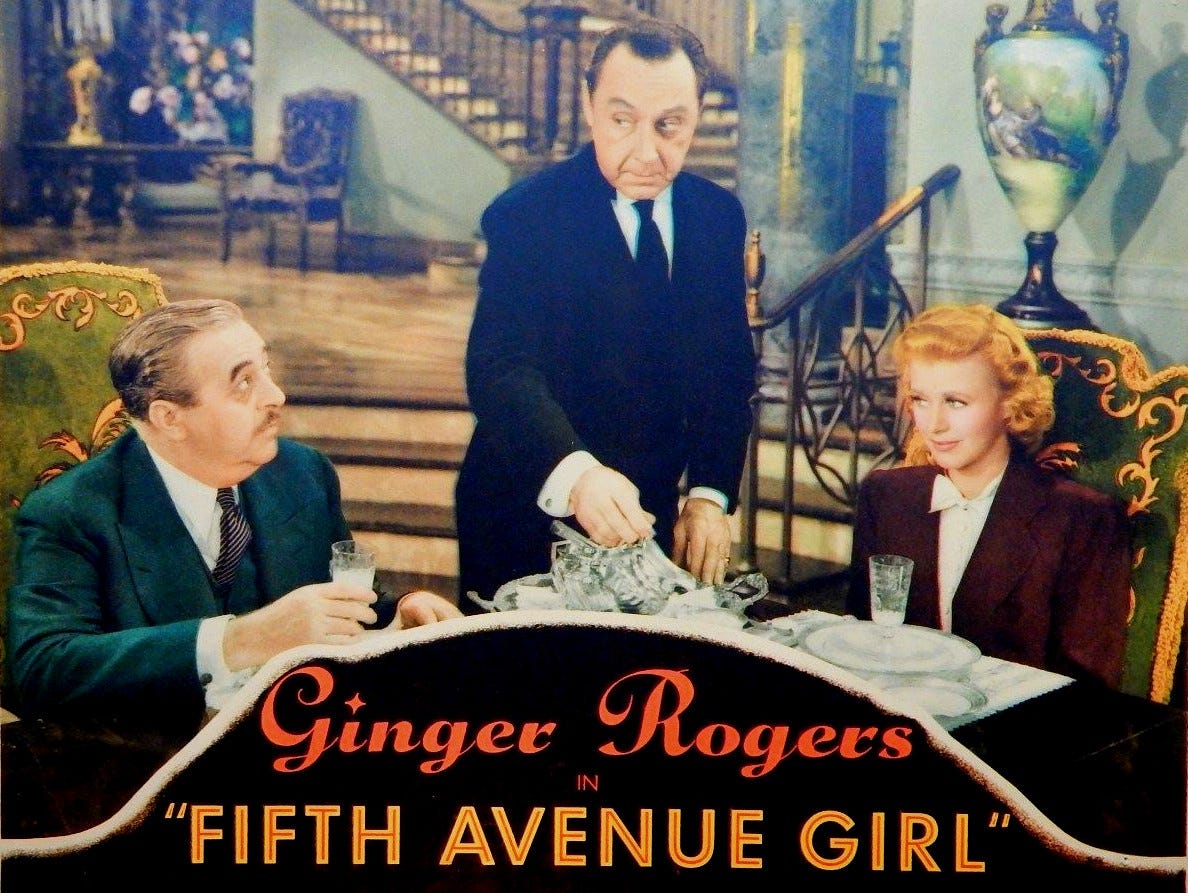
Fifth Avenue Girl (1939). Directed by Gregory La Cava. With Ginger Rogers, Walter Connolly, Veree Teasdale, Tim Holt, Kathryn Adams, James Ellison. Written by Allan Scott. Cinematography by Robert De Grasse. Music by Russell Bennett. Black and white. 1 hr., 23 mins. Streaming on Hulu and HBO Max.
This delightful yet somewhat restrained (not truly screwball) comedy was RKO’s biggest hit of 1939. Walter Connolly plays wealthy Timothy Borden, the owner of a pump manufacturing company who goes out one night to celebrate his birthday by his lonesome self, since his family doesn’t give a damn. He meets young, down-on-her-luck, Mary Grey (Rogers) on a park bench, and he convinces her to join him for dinner at a posh restaurant. Then he hires her to pose as his mistress, even installing her in the guest room of his house, in a foolhardy attempt to shock his wife (Teasdale) and family out of their disaffection for him, and their crass insouciance. The film is, after all, a Depression-era lampoon of the rich. The ruse works, but it also inspires his daughter (Adams) to fall in love with their Marxist chauffeur (Ellison), and his son (Holt) to fall for his dad’s supposed paramour. Connolly, who usually plays bumbling authority figures, is winsome in one of his last performances before his fatal stroke a year later. Holt’s role is much like his snooty George Minafer in The Magnificent Ambersons, a bratty rich kid. Many hilarious twists. Rogers’s character seems the only one with innate sense, and is, in effect, the straight-man role.
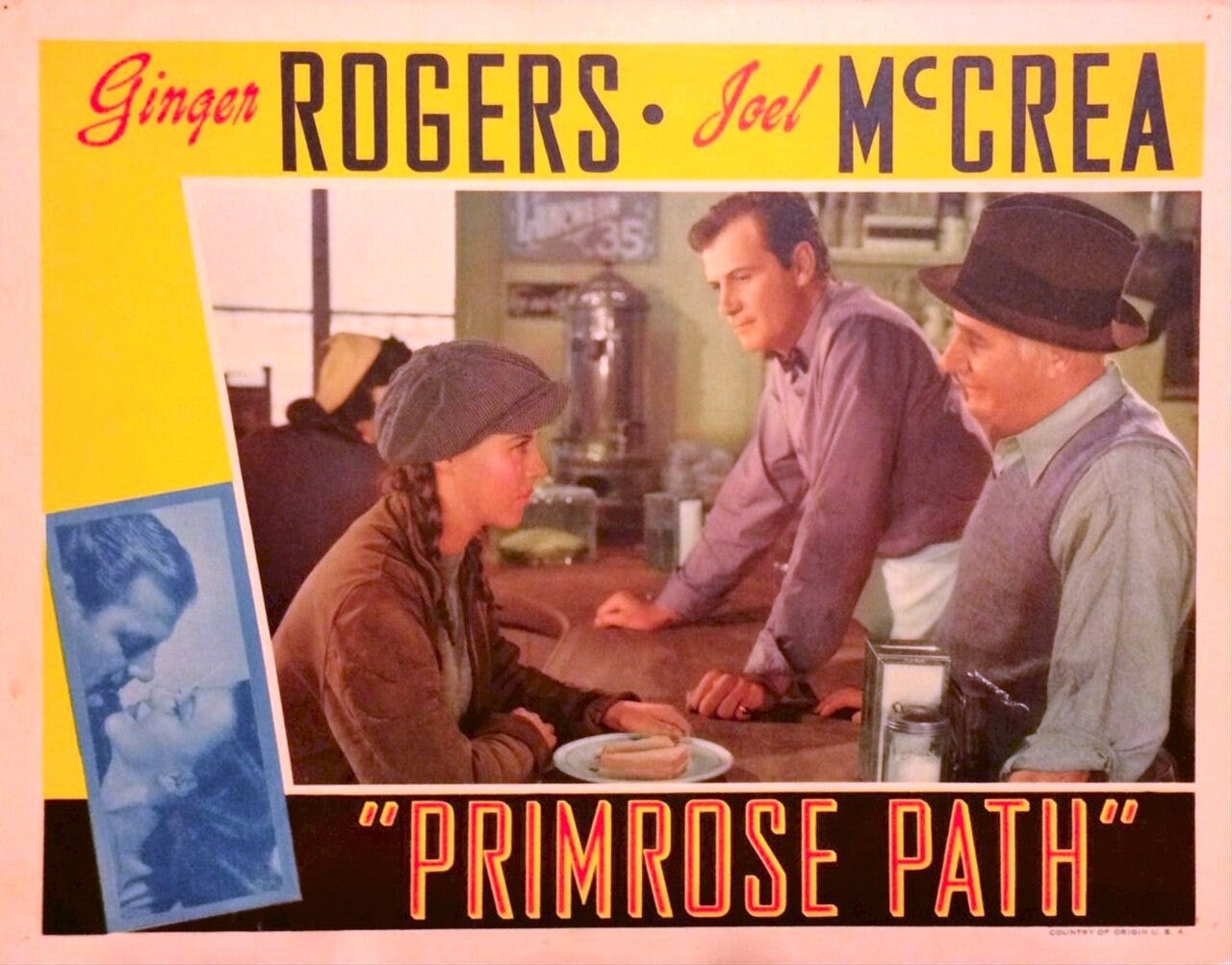
Primrose Path (1940). Directed by Gregory La Cava. With Ginger Rogers, Joel McCrea, Marjorie Rambeau, Henry Travers, Queenie Vassar, Joan Carroll, Miles Mander. Written by La Cava and Allan Scott. Cinematography by Joseph H. August. Music by Werner R. Heymann. Black and white, 1 hr., 33 mins. Streaming on Prime.
Ginger Rogers proves her remarkable versatility, playing, at twenty-nine, a penniless teenage girl, Ellie May Adams. She falls for Ed (McCrea) whose father owns the local diner-gas station where he also works. They quickly marry, and Ellie May’s hard work and quick wit as a waitress makes her a favorite of diners. But Ed rejects her when he meets her disreputable family on Primrose Hill, the bad side of town. She’d lied to him about her background: her mother (Rambeau) is a prostitute, her grandmother (Vassar) is a crusty former hooker, and her father (Mander) is a notorious, hopeless drunk. Ed’s father (played endearingly by Travers) tries to talk sense to his son, but he’s unmoved. Can Ellie May save her marriage (or should she) while also helping her family through a crisis when her father accidentally shoots her mother? Especially good performances by Rogers and Rambeau. It’s the first substantial break for eight-year-old Joan Carroll who brilliantly plays Ellie May’s little sister Honeyball. Marvelously convincing sets, and moody cinematography.
SOURCES:
“Andrea Leeds, 70, Ex-Actress.” New York Times obituary. May 23, 1984.
Harvey, James. Romantic Comedy in Hollywood: From Lubitsch to Sturges. Da Capo Press, 1998.
Larson, Allen. “1937: Movies and New Constructions of the American Star.” American Cinema of the 1930s: Themes and Variations. Ina Rae Hark, edtr. Rutgers University Press, 2007. Pps: 191-195.
Morris, Gary. “Forgotten Master: The Career of Gregory La Cava.” Bright Lights Film Journal, April 30, 2004.
Pratt, Kelee. Outspoken and Freckled: Stage Door, 1937 kelleepratt.com/ 2026/03/12/stage-door-1937/
ACKNOWLEDGEMENTS:
Thanks to Barry Voorhees for Editing
Thanks to Tim Madigan for Suggestions

Great post! Love the personal anecdote in the Stage Door section.